
Updated October 2026 · Reviewed by Billy Forte
The Texas drivers license written test is the DPS Class C knowledge exam, and you need a score of 70 percent or better to pass it. It covers traffic signs and Texas traffic laws, including duties toward people on bicycles and the effects of phone use and other distractions. A test passed in a TDLR-licensed adult driver education course can count for the sign and law parts, with limits explained below.
Key Facts
- Passing score: 70 percent or better, says the DPS handbook. See the passing score.
- Topics: signs, traffic laws, bicyclists, and phone use and distractions. See what it covers.
- Tries: three per application and fee, with the application held 90 days. See tries and the hold.
- Course test: a test passed in a licensed course can count for the sign and law parts. See how ADE may help.
- Study source: the free Texas Driver Handbook, with review questions in its appendix. See how to study.
What the Written Test Is
DPS calls it the knowledge exam. The Texas Driver Handbook lists three kinds. The one for a first car license is “Class C – Knowledge exam for all original applicants.”
The other two are for motorcycles and for large Class A or B vehicles. This guide covers only Class C.
The DPS apply page puts it in one line: “Pass the written knowledge and a practical driving skills test.” The knowledge test comes after the vision test and before the driving test.
What the Texas Drivers License Written Test Covers
Texas law sets the subjects. Transportation Code § 521.161 says the DPS exam must test:
- Your ability to read and understand highway signs in English.
- Your knowledge of Texas traffic laws.
- Your duties toward people riding bicycles.
- The effects of using a phone and other distractions while driving.
The same section also covers vision and a vehicle-control test. Those are separate from the written part.
The handbook is where these topics are explained. Here is where to find each one:
| Topic | Handbook chapter to study |
|---|---|
| Highway signs | Chapter 5: Signals, Signs, and Markers |
| Who goes first | Chapter 4: Right-of-Way |
| Turns, signals and passing | Chapter 6: Signaling, Passing, and Turning |
| Parking and stopping | Chapter 7: Parking, Stopping, or Standing |
| Speed rules | Chapter 8: Speed and Speed Limits |
| Phones and texting | Chapter 9: Some Special Driving Situations |
| Duties toward bicyclists | Chapter 13: Bicycle Laws and Safety |
The handbook has other chapters too. They cover alcohol and drugs, crashes, pedestrian safety and more. Read them as well, since they explain Texas traffic laws.
Sign Shapes and Colors
Reading signs is the first subject the law names. Chapter 5 of the handbook gives each shape a job. Knowing the shape helps you read a sign from far away.
| Sign shape | What the handbook says it is used for |
|---|---|
| Octagon | “Exclusively for stop signs” |
| Equilateral triangle | “Exclusively for yield signs” |
| Round | Railroad advance warning signs |
| Diamond | Warnings of hazards on or near the road |
| Pentagon | School advance and school crossing signs |
| Horizontal rectangle | Guide signs, in general |
| Vertical rectangle | Regulatory signs, in general |
Colors carry meaning too. The handbook says red means stop, yield or do what the sign says.
Yellow is a general warning, and orange warns of construction and maintenance. Green shows allowed moves and directions, blue guides you to services, and brown points to recreation and scenic areas.
Signal Lights
Chapter 5 also explains flashing and arrow lights. Here is what it says:
- Flashing red. Stop completely before the crosswalk or intersection, then go when it is safe.
- Flashing yellow. Slow down and go ahead with caution.
- Green arrow with a red light. Go in the arrow’s direction after yielding the right-of-way.
- Flashing yellow arrow. You may turn left, but you must yield to oncoming traffic.
The Passing Score
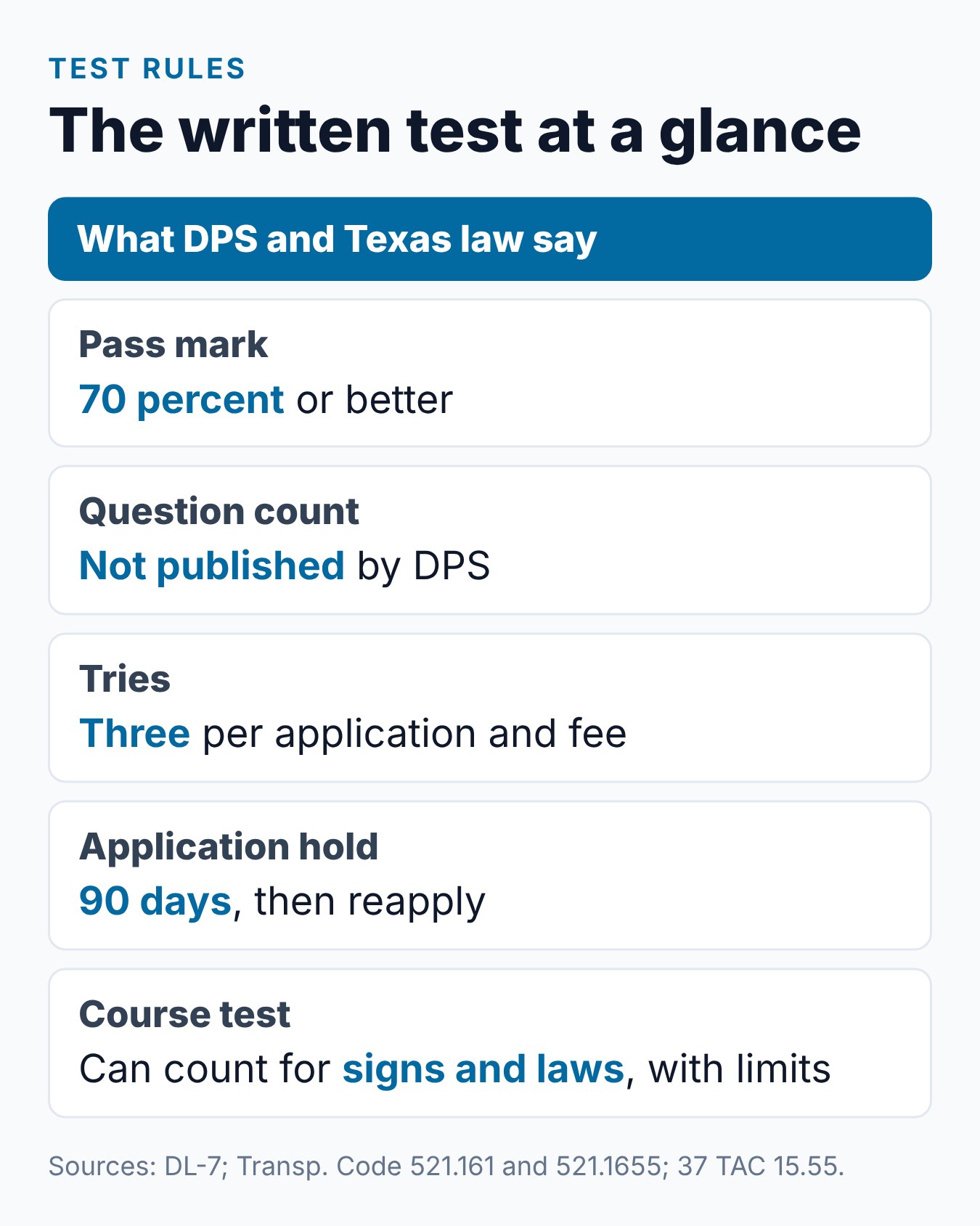
The handbook gives one number. “You must score a grade of 70 percent or better to pass any knowledge exam.”
DPS does not publish how many questions are on the test. We found no DPS page that gives a count. If a website states one, it did not come from DPS.
So aim to know the whole handbook, not a set number of answers. A 70 percent score is the line DPS draws.
How ADE May Help
Texas law lets a TDLR-licensed driver education provider give the sign and law parts of the DPS exam, and a test passed there counts for those parts. The handbook says that after “certain courses,” you do not take the knowledge exam at the office. Ask your provider whether its course gives this test.
There are limits. Under 37 TAC 15.55, applicants under 25 with a certificate dated two or more years before they apply get no exams waived. No official source says the course test counts for adults 25 and older who take it by choice.
Our guide on whether adult driver education waives the written test explains the rules in full. For the tests inside the course, see the Texas adult driver education test.
Three Tries and the 90-Day Hold
You do not get unlimited tries on one application. Transportation Code § 521.161(d) allows three attempts at each part of the exam after you pay the fee.
The handbook adds a time limit. “If you do not pass the knowledge and driving exams on your first attempt, your application will be held for 90 days.” After 90 days or three failed exams, you need a new application and fee.
Here is what that means in practice:
- Your first try is part of your application.
- If you miss 70 percent, you can try again under the same application.
- After the third failed try, you start a new application and pay again.
- If 90 days pass first, you also start over.
DPS states no waiting period between tries. Plan your study time so you are ready before each one.
How to Study
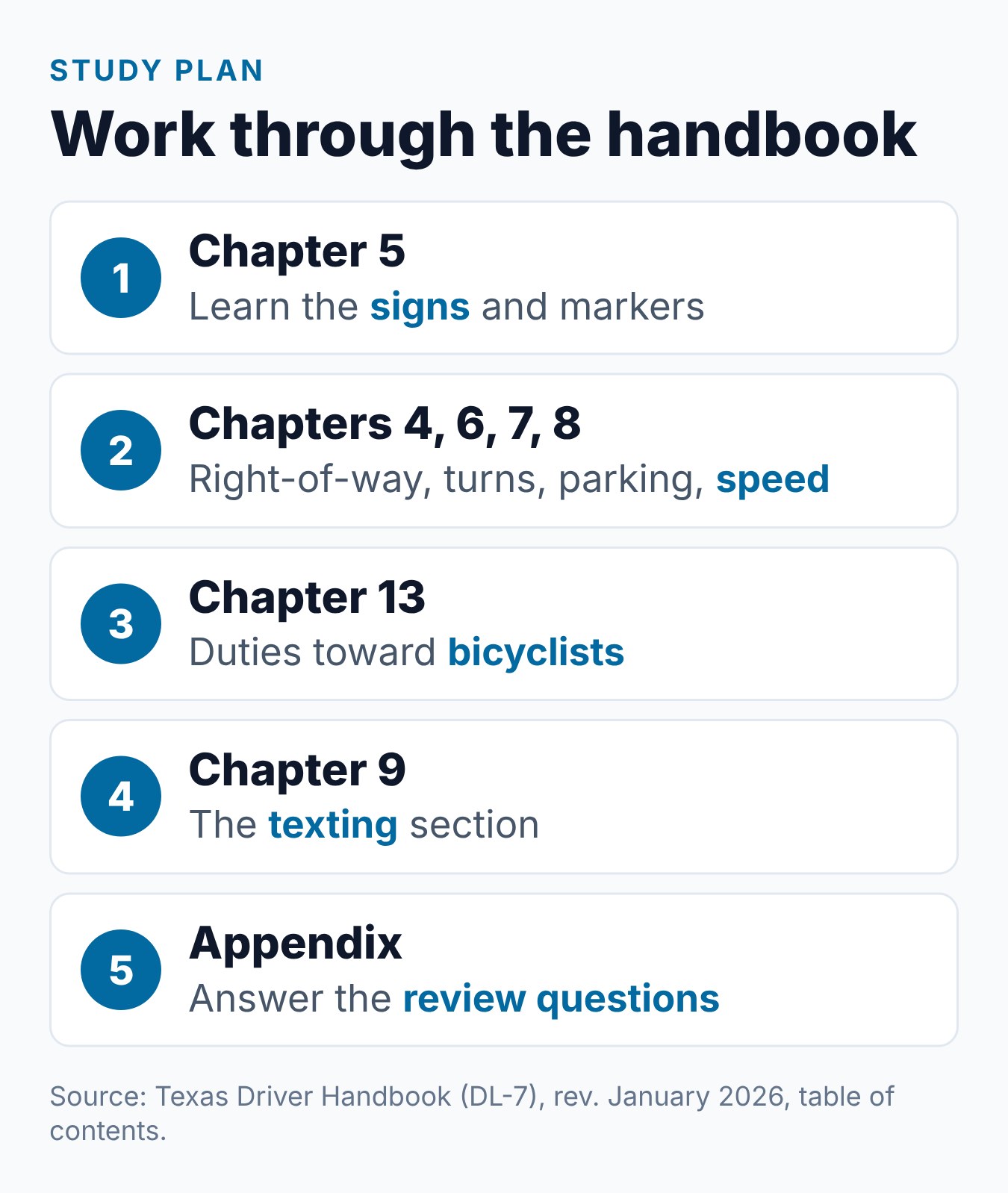
The handbook is free online, and it is the source DPS writes. It has an appendix called “Study and Review Questions for Class C Operators.” It also has a glossary of terms.
Use these steps:
- Start with signs. Chapter 5 shows the signals, signs and markers you need to read.
- Learn the rules of the road. Chapters 4, 6, 7 and 8 cover right-of-way, turns, parking and speed.
- Cover bikes and phones. The law names both, so read Chapter 13 and the texting part of Chapter 9.
- Use the review questions. Answer them without looking, then check the chapter for any you miss.
- Read the glossary. It defines words you will see on the test.
Practice sites made by other companies are not DPS sources. Use them only to check what you learned from the handbook.
Who Takes the Written Test
The Class C knowledge exam is for “all original applicants,” says the handbook. That covers adults 18 to 24 and adults 25 and older getting a first Texas license.
A course test may count for the sign and law parts, as explained above. Adults 25 and older who skip the course take the knowledge test at DPS.
New residents can be exempt. The DPS Moving to Texas page says adults 18 and older with a valid out-of-state license are exempt from the knowledge and skills exams. DPS also accepts one not expired over two years.
Before You Sit the Test
You take the DPS knowledge test during your office visit, so the visit rules apply. The handbook says the fee must be paid before any exams are given for an original license.
The DPS appointments page says to arrive no earlier than 30 minutes before your time. It also says appointments are cancelled after 30 minutes. Our guide on how to book a Texas DPS appointment covers the rest.
Where the Course Tests Come From
TDLR rules require tests on signs and laws inside the adult course. In a classroom course, 16 TAC 84.502 requires at least 70 percent on a highway signs exam and on a traffic laws exam.
Online courses follow 16 TAC 84.503. The final exam has at least 30 questions on highway signs and traffic laws. That is the course’s minimum, not the DPS test’s question count.
DPS also has an FAQ for driver education schools. It says DPS sends knowledge tests by email for “the sole use of your driver education school.”
What We Found on the Official Pages
On the DPS pages we checked on October 26, 2026, the handbook was revision January 2026. It gave the 70 percent pass mark and listed the three kinds of knowledge exams. It did not give a question count.
The DPS apply page listed the written knowledge test as a step for adults. It did not mention a course test counting for it. The handbook’s “certain courses” line was the only DPS mention we found.
Common Mistakes to Avoid
Each item comes from Texas law, a DPS rule or the handbook:
- Studying for a set number of questions. DPS publishes only the 70 percent pass mark.
- Skipping the bike and phone topics. The law names both.
- Waiting too long to retest. The application is held for 90 days.
- Using an old course certificate. Under 25, a certificate two or more years old waives no exams.
- Assuming a course counts at 25 or older. No official source confirms it.
- Not asking your provider. Confirm the course gives the sign and law test before you rely on it.
How Requirements Can Vary
Texas driver license rules come from state law, Texas DPS rules and TDLR rules, and they apply statewide. What you need still depends on your age, whether you hold a license from another state, and which tests you have already passed.
Laws, fees and office procedures can change. Check the Texas DPS and TDLR websites for current rules before you book an appointment or enroll in a course.
Frequently Asked Questions
What score do I need on the Texas written test?
You need 70 percent or better. The handbook says that score applies to “any knowledge exam.”
How many questions are on the Texas written test?
DPS does not publish a question count. It publishes only the 70 percent pass mark.
What happens if I fail the written test?
You can try again under the same application. Texas law allows three tries per application and fee, and DPS holds the application for 90 days.
Does adult driver education skip the written test?
A test passed in a TDLR-licensed course can count for the sign and law parts. Under 25, a certificate dated two or more years before you apply waives no exams. Ask your provider whether its course gives this test.
Do I take the written test if I am 25 or older?
Yes, plan on it. No official source says a course test counts for adults 25 and older who take the course by choice.
What should I study?
Study the free Texas Driver Handbook. Focus on signs, traffic laws, bicycle duties and phone use, then use the review questions in its appendix.
What comes right before the written test?
The DPS apply page lists the vision exam before the written knowledge test. The driving test comes only after all other exams are passed.
Is the written test the same for teens and adults?
The handbook calls the Class C test the “Knowledge exam for all original applicants.” It names no separate adult version. The pass mark is 70 percent for any knowledge exam.
Conclusion
The Texas written test checks signs and traffic laws, and DPS sets the pass mark at 70 percent. Study the free handbook, and if you are 18 to 24, ask your provider whether its course gives the sign and law test. You can start the six-hour course with Driving Logic’s online Texas adult driver education course.
Related Articles
- Texas Driving Test: What to Expect and How to Prepare
- Does Texas Adult Driver Education Waive the Written Test at DPS?
- Texas Adult Driver Education Test: What to Expect
- Texas DPS Vision Test: What to Expect
Sources
- Texas DPS — Texas Driver Handbook (DL-7, PDF)
- Texas Transportation Code Chapter 521 — Driver’s Licenses (PDF)
- 37 Tex. Admin. Code § 15.55 — Examination requirements
- Texas DPS — Apply for a Texas Driver License
- Texas DPS — Driver License Services Appointments
- Texas DPS — Moving to Texas
- 16 Tex. Admin. Code § 84.502 — Adult driver education (in person)
- 16 Tex. Admin. Code § 84.503 — Adult driver education (online)
Billy Forte is the owner of Driving Logic, a state-approved driver improvement course provider serving Texas and other U.S. states.
This article is general information, not legal advice. Texas driver license and driver education rules are set by Texas law, Texas DPS and TDLR, and they can change. Check the official DPS and TDLR websites for current requirements before you apply.