
Updated October 2026 · Reviewed by Billy Forte
The Texas DPS vision test is an eye check at the driver license office, and every applicant for an original license takes it. Under DPS rule 37 TAC 15.51, 20/40 or better in each eye and both eyes together, without glasses, means no vision restriction. Weaker scores can add a lens, daytime-only or 45 mph restriction, and worse than 20/70 in the best eye fails.
Key Facts
- No restriction: 20/40 or better in each eye and both together, without lenses. See the standards.
- Lens restriction: 20/50 or better with glasses or contacts. See glasses and contacts.
- Extra limits: 20/60 to 20/70 adds daytime-only and 45 mph limits. See daytime and speed limits.
- Color: DPS checks color blindness for every original applicant. See the color check.
- After surgery: a 2025 law, HB 647, lets you ask DPS to remove a lens restriction. See HB 647.
What the Texas DPS Vision Test Is
Texas law says DPS must examine each license applicant. Transportation Code § 521.161 lists vision first among the parts of that exam. The vision test is one step on the DPS apply page, along with the knowledge and driving tests.
DPS rule 37 TAC 15.62 says applicants doing an original or renewal license transaction at a driver license office must take a vision test there. So even if you test the driving part at a certified school, the eye check happens at DPS.
The Texas Driver Handbook covers it in Chapter 1, Part 2, “The Vision Examination.” It is short. The detailed scores are in the DPS rule.
Where It Fits in Your Visit
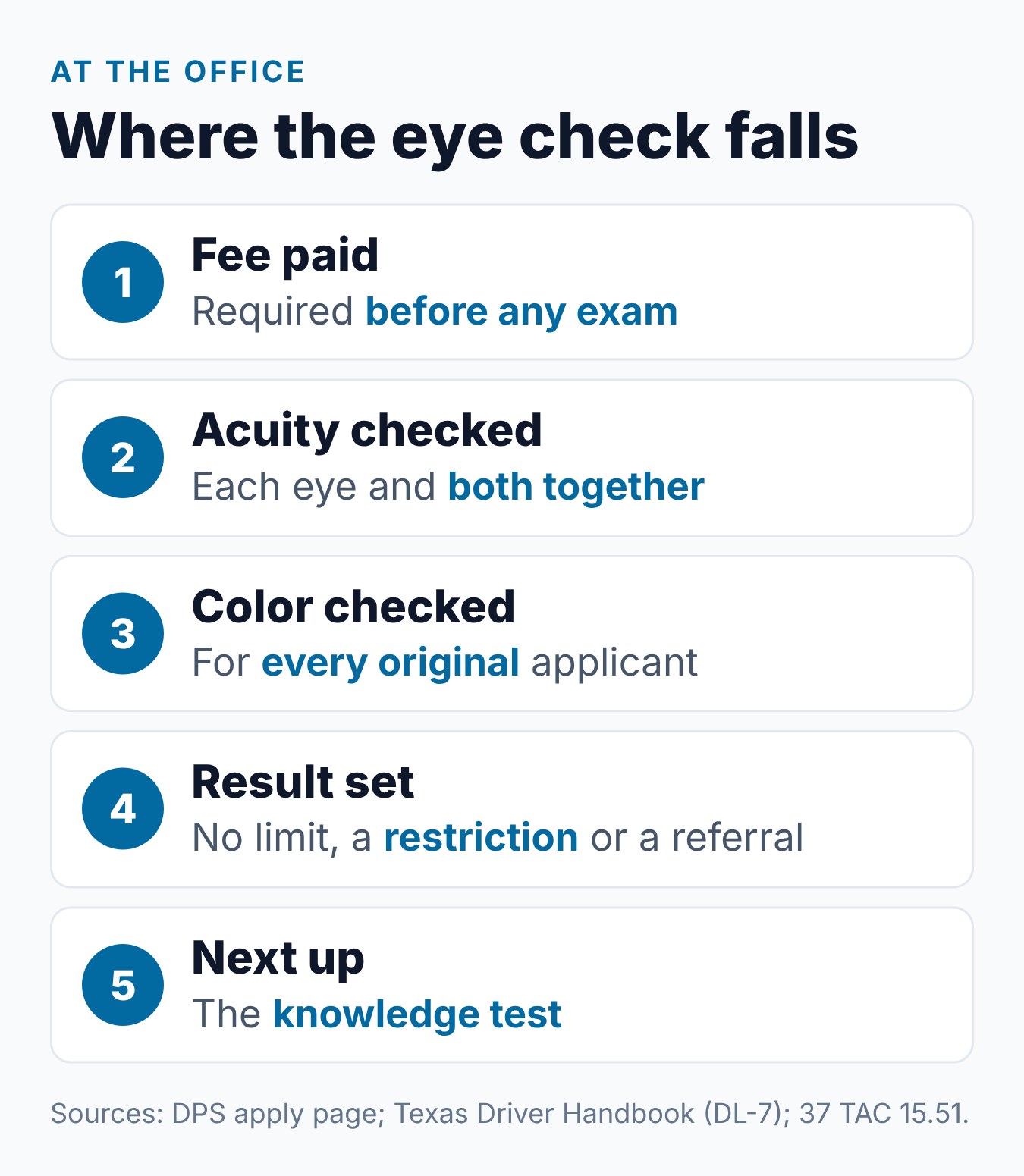
The vision test comes after the paperwork. The DPS apply page lists these steps at the office:
- Hand in your application and documents.
- Give your thumbprints and signature, and have your photo taken.
- Pay the fee.
- Pass the vision exam.
- Pass the knowledge test and the driving test.
The handbook says the fee must be paid before any exams are given for an original license. The driving test comes last, after every other exam is passed. Our Texas driving test guide covers the full order.
Texas Vision Standards
The scores come from 37 TAC 15.51. Each score is written like 20/40, and the rule sets what each range means.
Here is what each two-eyed score means under the rule:
| Your score | What the rule says happens |
|---|---|
| 20/40 or better, each eye and both, no lenses | No vision restriction |
| Worse than 20/40 without lenses | Referred to a specialist |
| 20/50 or better with lenses, best eye or both | Restricted to corrective lenses |
| 20/50 or better without lenses, plus a specialist statement | No restriction |
| 20/60 or 20/70 with lenses | Lenses, daytime only, 45 mph and other limits |
| 20/60 or 20/70 without lenses, plus a specialist statement | Daytime only, 45 mph and other limits |
| Worse than 20/70, best eye or both | Fail, if no more improvement is possible |
“Best eye or both together” means DPS can look at your stronger eye or at both eyes at once. A “specialist statement” is a written note from an eye specialist that your vision cannot be improved.
One-Eyed Vision
The rule has a separate standard for people who see with one eye. Without lenses, 20/25 or better in the best eye means no restriction. Worse than 20/25 means a referral to a specialist.
For other cases, the rule says to use the two-eyed standards above. If this applies to you, bring any notes from your eye doctor.
What Counts as Blind
The rule also defines blindness for licensing. A score worse than 20/200, even with lenses, counts as blind. A specialist’s statement that 20/200 is not possible also counts.
Glasses, Contacts and the Lens Restriction
You can wear glasses or contacts for the test. The handbook says you “may be required to wear corrective lenses” while driving if they improve your vision.
If you pass only with lenses, DPS adds a corrective-lens restriction to your license. That means you must wear them each time you drive. The handbook has a list of restriction codes in its appendix.
So bring the glasses or contacts you drive with. If you test without them and score worse than 20/40, the rule calls for a referral, not an instant pass.
Daytime-Only and 45 mph Limits
Scores of 20/60 or 20/70 bring stricter limits. With lenses, the rule restricts the license to:
- Corrective lenses.
- Daytime driving only.
- A top speed of 45 mph.
- Any other limit DPS finds advisable.
The same daytime and 45 mph limits apply without lenses when a specialist says your vision cannot improve. These limits become part of your license, so plan your driving around them.
The Color Blindness Check
The rule says plainly: “Color blindness is checked on all original applicants.” So expect a color check at your first visit.
The rule does not say that color blindness alone fails the test. It also does not describe how the check is given. If you know you have trouble with colors, ask the DPS specialist what to expect.
Referral to a Specialist
A referral is not a fail. It means DPS wants an eye specialist’s opinion before it decides. The rule sends some applicants to a specialist, such as when unaided vision is worse than 20/40.
The handbook adds a second case. “If the results are inconclusive, you may be referred to your doctor.” Bring the specialist’s written statement back to DPS when you return.
A specialist statement can change the outcome in two ways under the rule. With 20/50 or better and a statement that your vision cannot improve, you get no restriction. With 20/60 or 20/70 and the same kind of statement, you get daytime-only and 45 mph limits instead of a fail.
Who Takes the Vision Test
Every applicant for an original Texas license takes the vision test. That includes adults 18 to 24 who took the six-hour course and adults 25 and older who did not.
New residents follow a different path for some tests. The DPS Moving to Texas page says adults 18 and older with a valid out-of-state license are exempt from the knowledge and skills exams. DPS also accepts one not expired over two years.
That exemption list names the knowledge and skills exams, ITD and adult driver education. It does not name the vision test. DPS rule 37 TAC 15.55 adds that with no license, or one expired more than two years, the vision, knowledge and skills exams are all required.
If You Need Another Try
Texas law gives each part of the exam a set number of tries. Under Transportation Code § 521.161(d), you get three attempts at each part for one application and fee.
The handbook also says DPS holds your application for 90 days. After 90 days or three failed exams, you need a new application and fee. If a specialist visit is needed, plan it inside that window.
A new eye exam, new glasses or a specialist’s statement can change your result. Bring the paperwork to DPS when you return.
HB 647: Removing a Lens Restriction
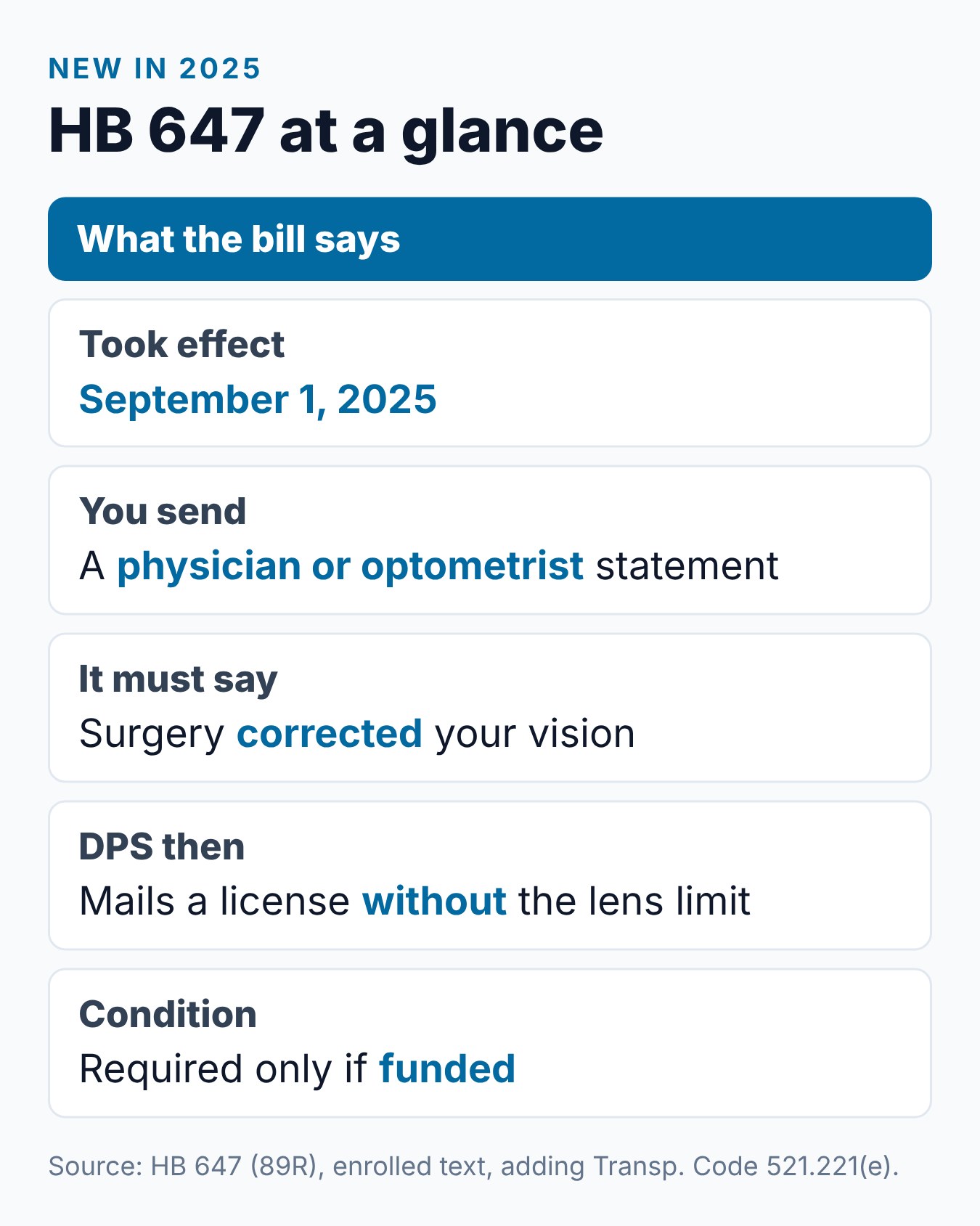
A 2025 law gives a way to drop a lens restriction after eye surgery. HB 647 added subsection (e) to Transportation Code § 521.221. It took effect on September 1, 2025.
Here is how it works under the bill text:
- You send DPS a written statement from a licensed physician or optometrist.
- The statement says surgery has corrected your vision.
- You pay the required fee.
- DPS removes the restriction and mails you a new license without it.
The bill also tells DPS to set up a way to send the form and fee online or by mail. It has one condition. DPS must carry it out only if the Legislature funds it, though DPS may use other funds.
Check with DPS for the current form and fee before you send anything. The bill text does not name them.
Preparing for the Vision Test
You cannot study for an eye test, but you can plan. These steps follow the rule and the handbook:
- Bring your lenses. Wear the glasses or contacts you drive with.
- Know your last eye exam. If you are unsure you meet 20/40, an eye doctor can check before your visit.
- Bring specialist notes. If you have one-eyed vision or a known condition, bring written statements.
- Plan for the other tests. The knowledge test and the driving test come after the vision test.
The knowledge test is next in line. See our Texas written knowledge test guide for what it covers.
What We Found on the Official Pages
On the rule and DPS pages we checked on October 26, 2026, 37 TAC 15.51 showed its last change in August 2002. Its tests were acuity scores and a color blindness check. It named no other type of eye test.
The handbook, revised January 2026, gave a short summary and pointed to restriction codes in its appendix. We found no DPS page that showed the HB 647 form or fee.
Common Mistakes to Avoid
Each item comes from the DPS rule, the handbook or HB 647:
- Leaving your glasses at home. You may need them to reach 20/50 and pass with a lens restriction.
- Treating a referral as a fail. A specialist statement can change the result.
- Ignoring a daytime limit. The license terms apply each time you drive.
- Assuming surgery clears the restriction. Under HB 647, you still send a doctor’s statement and the fee.
- Skipping the office step. The vision test for an original license happens at the DPS office.
How Requirements Can Vary
Texas driver license rules come from state law, Texas DPS rules and TDLR rules, and they apply statewide. What you need still depends on your age, whether you hold a license from another state, and which tests you have already passed.
Laws, fees and office procedures can change. Check the Texas DPS and TDLR websites for current rules before you book an appointment or enroll in a course.
Frequently Asked Questions
What vision do I need for a Texas driver license?
You need 20/40 or better in each eye and both together, without lenses, for no restriction. With lenses, 20/50 or better passes with a corrective-lens restriction. Worse than 20/70 in the best eye fails if it cannot be improved.
Can I wear glasses or contacts for the vision test?
Yes. If you pass only with lenses, DPS adds a corrective-lens restriction. You must then wear them each time you drive.
Does DPS test for color blindness?
Yes. The rule says color blindness is checked on all original applicants. It does not say color blindness alone fails the test.
What happens if I do not pass the vision test?
DPS may refer you to an eye specialist or your doctor. A specialist’s statement can lead to a license with limits, such as daytime only. Worse than 20/70 with no further improvement fails.
Can I take the vision test at a third-party school?
DPS rule 37 TAC 15.62 says applicants doing an original or renewal transaction at a driver license office must take a vision test there. Certified schools give the driving test.
Can I remove my lens restriction after eye surgery?
Yes, under HB 647, which took effect September 1, 2025. You send DPS a doctor’s or optometrist’s statement and the fee, and DPS mails a new license. The law depends on funding.
Is the vision test the same for renewals?
DPS rule 37 TAC 15.62 requires a vision test for renewals done at a driver license office too. The color blindness check in 37 TAC 15.51 applies to original applicants.
Does the vision test come before the knowledge test?
Yes. The DPS apply page lists the vision exam right after the fee, then the knowledge and driving tests. The driving test always comes last, after every other exam is passed.
Conclusion
The Texas DPS vision test uses the scores in 37 TAC 15.51, from 20/40 with no restriction to worse than 20/70 as a fail. Bring your lenses, and bring any specialist notes you have. Adults 18 to 24 also need the six-hour course before the road test, and you can begin with Driving Logic’s online Texas adult driver education course.
Related Articles
- Texas Driving Test: What to Expect and How to Prepare
- Texas DPS Written Knowledge Test: What It Covers and How ADE May Help
- Texas Drivers License Test: Skills and Maneuvers Graded
Sources
- 37 Tex. Admin. Code § 15.51 — Vision standards
- Texas DPS — Texas Driver Handbook (DL-7, PDF)
- Texas HB 647 (2025), enrolled bill (PDF)
- 37 Tex. Admin. Code § 15.62 — Impact Texas Drivers program
- 37 Tex. Admin. Code § 15.55 — Examination requirements
- Texas DPS — Apply for a Texas Driver License
- Texas DPS — Moving to Texas
- Texas Transportation Code Chapter 521 — Driver’s Licenses (PDF)
Billy Forte is the owner of Driving Logic, a state-approved driver improvement course provider serving Texas and other U.S. states.
This article is general information, not legal advice. Texas driver license and driver education rules are set by Texas law, Texas DPS and TDLR, and they can change. Check the official DPS and TDLR websites for current requirements before you apply.