
Updated October 2026 · Reviewed by Billy Forte
A Texas speeding ticket out of state drivers receive stays with the Texas court named on the citation, and if it ends in a conviction, Texas reports it to your home state under the Driver License Compact. The Texas right to dismiss a ticket with a driving safety course is limited to Texas license or permit holders and active-duty military families. Other drivers should contact the court by the answer date to ask what it offers.
Key Facts
- Texas court: your case is heard where the ticket was written, not in your home state. See where the case is heard.
- Compact reporting: Texas must report an out-of-state driver’s conviction to the home state. See the Driver License Compact.
- Course right: it needs a Texas license or permit, or active-duty military family status. See the course rule.
- Other options: deferred disposition is up to the judge, and it is not open to CDL holders. See your options.
- Do not skip court: breaking a written promise to appear on purpose is its own misdemeanor. See appearing.
Where Your Case Is Heard
For speeding, a Texas officer must issue a written notice to appear if you sign a written promise to appear. Transportation Code Chapter 543 sets this rule. Signing is how you get released at the roadside.
The notice names a court in the city or county where the offense happened. The date must be at least 10 days after the stop, unless you ask for an earlier hearing. Your home state’s courts do not handle the case.
The court will be a justice court or a municipal court. Find its name, address and phone number on the citation. That court decides the fine, the costs and which options it offers.
How the Driver License Compact Works
Texas is a member of the Driver License Compact of 1993. It is part of Texas law in Transportation Code Chapter 523. The stated goal is to promote compliance with traffic laws across member states.
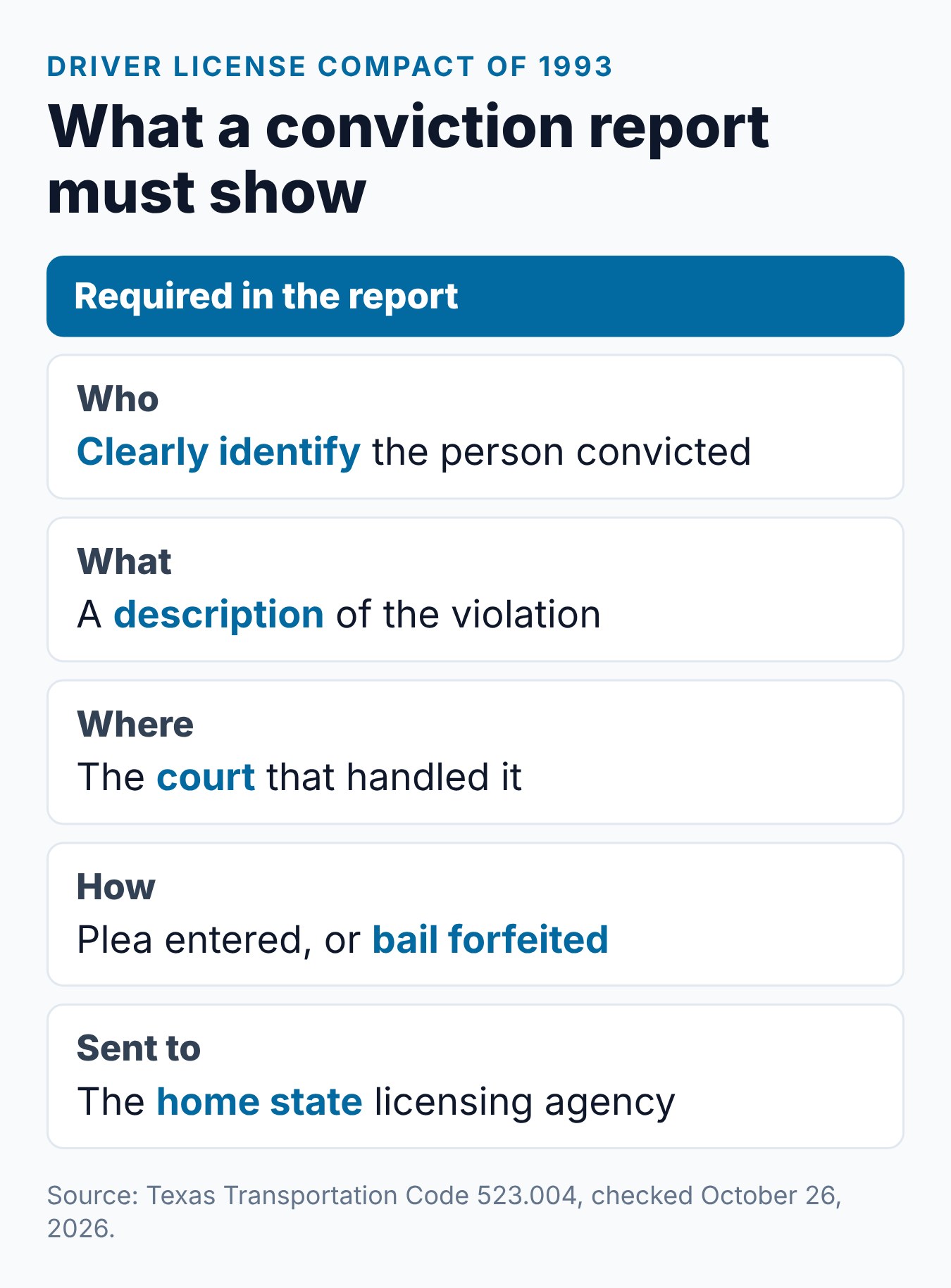
The key duty is reporting. When a driver from another member state is convicted, the licensing authority must report it to the driver’s home state. Each report must:
- Clearly identify the person convicted.
- Describe the violation.
- Identify the court.
- Show whether the person pleaded guilty or not guilty, or whether the conviction came from a forfeited bail or bond.
What the Home State Does With a Report
The compact lists a few serious offenses that the home state must treat as if they happened there. For other convictions, it says the home state gives the conduct “such effect” as its own laws provide.
That means your home state’s rules decide what a Texas speeding conviction does to your license there. Ask your home state’s licensing agency how it treats an out-of-state conviction.
The Driving Safety Course and Your License
Texas lets eligible drivers have a ticket dismissed by finishing a driving safety course. Under Code of Criminal Procedure Chapter 45A, the right covers a driver who:
- Holds a Texas driver’s license or permit, or
- Is an active-duty member of the U.S. military, or a spouse or dependent child of one.
A driver with only another state’s license, who is not in one of those military groups, is not covered by that right. The court’s power to allow the course in other cases does not reach this condition. For the full license rule, see Texas defensive driving for out-of-state drivers.
Military families who qualify must still meet the other conditions. One of them looks back 12 months. A military driver without a Texas license must not have finished a course in another state in that time, either.
Texas Speeding Ticket Out of State Options
Each path below begins with a plea. Chapter 45A lists three: guilty, not guilty and nolo contendere (no contest). This is general information, so talk to the court or a lawyer before you choose.
Pay the Ticket
Paying means a plea of guilty or no contest. It ends in a conviction. The Texas court reports convictions to Texas DPS within 7 days, and the compact requires a report to your home state.
Contest the Ticket
You can plead not guilty and ask for a trial. Chapter 45A says you have the right to appear by an attorney. Ask the court how it schedules trials and whether a lawyer can appear for you.
Ask About Deferred Disposition
Deferred disposition does not require a Texas license. You plead guilty or no contest and pay court costs. The judge may then delay the case for up to 180 days and set conditions.
One of those conditions can be a driving safety course. If you meet the conditions, the judge dismisses the complaint.
This path is the judge’s choice, not a right, and it is not open to anyone who holds or held a CDL. Read what deferred disposition is for details.
Outcomes Compared
Whether an outcome is a conviction matters for the compact. This table shows how each path ends under Texas law.
| How the case ends | Is it a conviction? | Where the Texas court sends a record |
|---|---|---|
| You pay the ticket | Yes | Texas DPS, within 7 days |
| Found guilty at trial | Yes | Texas DPS, within 7 days |
| Found not guilty | No | No conviction to report |
| Deferred, conditions met | No, the complaint is dismissed | No conviction report while deferred |
For any conviction of a driver from another member state, the compact adds the report to the home state. Ask your home state how it handles that report.
If You Cannot Get Back to Texas
Distance does not cancel the case. Chapter 543 says a person who wilfully breaks a written promise to appear commits a misdemeanor. That is true no matter how the speeding charge ends.
The same chapter says you can comply through a lawyer’s appearance. Courts also set their own methods for some steps. Ask the clerk which steps you can handle by mail, e-mail, or an online portal.
If your citation requires you to appear in person, you must follow it. Only the court can change that.
Steps for Out-of-State Drivers
These steps follow from the rules above:
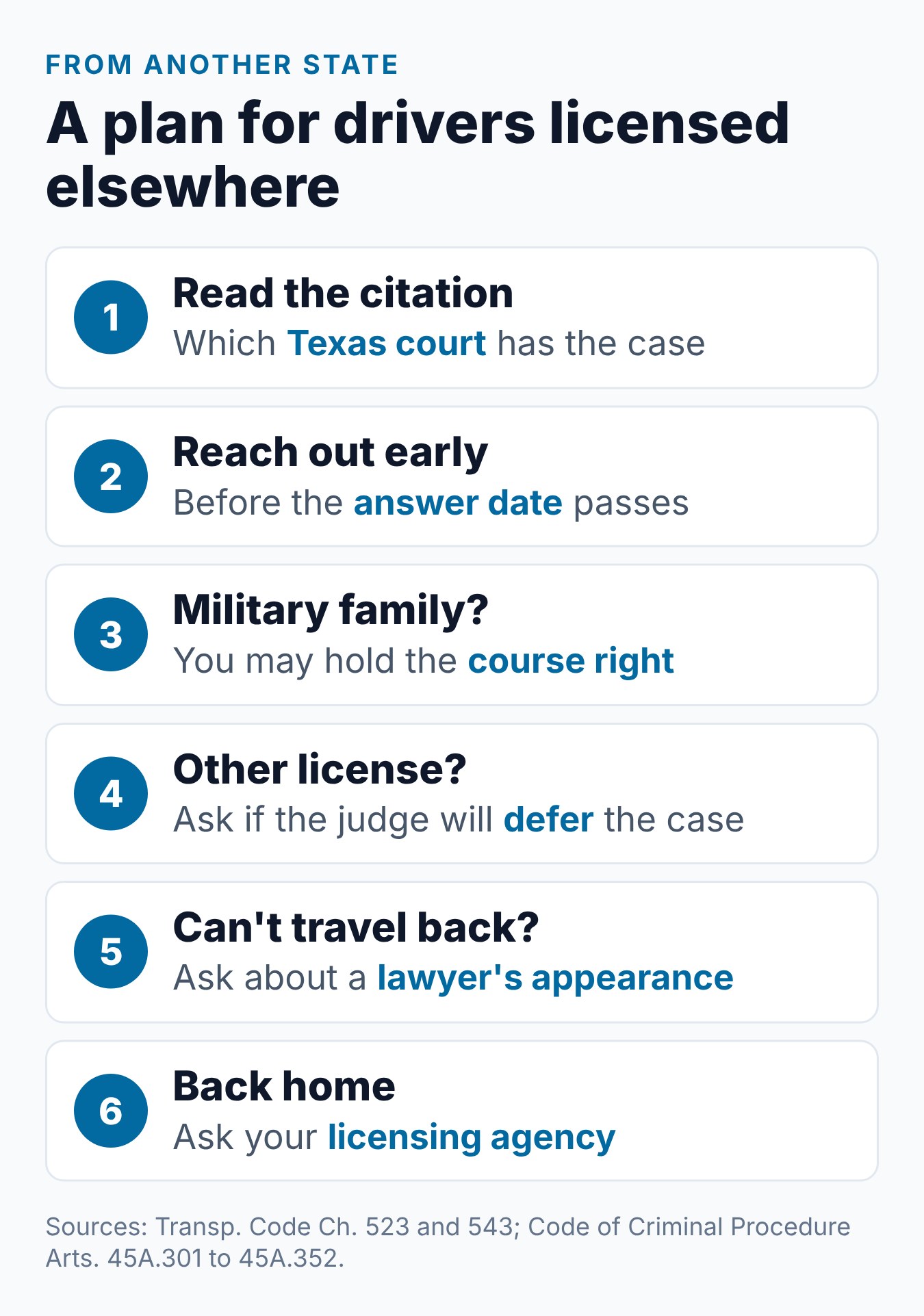
- Find the court, the answer date and the charge on your citation.
- Contact the court before the answer date and ask what options it offers.
- Ask about the fine, court costs and any appearance rules.
- If you are active-duty military or family, ask how to request the course.
- If not, ask whether the judge considers deferred disposition.
- Ask your home state’s licensing agency how it treats a Texas conviction.
Why the Answer Date Still Matters
The answer date is the court’s deadline for your first response. It is printed on the citation. For a Texas license holder or military family, it is also the last day to claim the course as a right.
For other drivers, it is the date to have a plan in place. Call the court before it passes. Ask what the court needs from you and by when.
If you are a military family member, check one more thing. The citation must tell you about the course. If it did not, Chapter 45A says your right to the course continues until that notice is given or the case ends.
If Paying in Full Is Hard
Being far from the court can make payment problems harder to sort out. Chapter 45A lets you tell the judge you are having trouble paying. You can do that by mailing a letter to the judge, among other ways.
The judge must then hold a hearing on whether the amount is an undue hardship. For that hearing, the judge may let you appear by phone or video if coming in person would be an undue hardship. For the payment choices a judge can use, see what affects a Texas speeding fine.
Questions for Your Home State
Your home state’s licensing agency is the source for what happens there. Ask it:
- How do you treat a speeding conviction reported from Texas?
- Does it change my license status or record here?
- Where can I see what was reported?
Keep a note of the answers with the date.
The Fine Is Set in Texas
Your license state does not change the Texas fine rules. Transportation Code Chapter 542 sets a general fine of $1 to $200 when no other penalty applies. The court sets the amount and adds court costs.
A guilty or no contest plea also brings the $50 state traffic fine. In a work zone with workers present, the minimum and maximum fines double.
What We Found in Chapter 523
On the Legislature’s compiled Chapter 523 text we checked on October 26, 2026, the compact’s reporting section listed four items each report must show. These were the person, the violation, the court, and the plea or bail forfeiture.
The text showed no 2025 changes to these sections. The latest history note we saw was from a 2023 bill.
Common Mistakes to Avoid
Each point is drawn from Texas law:
- Thinking the ticket stays in Texas. A conviction is reported to your home state under the compact.
- Assuming you can request the course by right. That right needs a Texas license or permit, or active-duty military family status.
- Ignoring the citation. A wilful broken promise to appear is a separate misdemeanor.
- Waiting past the answer date. It is the date to respond and to ask about your options.
- Guessing how your home state will react. Its own laws decide that, so ask its licensing agency.
How Requirements Can Vary
The driving safety course rules come from Texas law and TDLR and apply statewide. Each justice or municipal court still sets its own fees, filing steps and contact methods, and the facts of your citation decide which options you have.
Laws, fees and court procedures can change. Check your citation, ask the court that handles your case, and use the TDLR and Texas DPS websites for current rules before you act.
Frequently Asked Questions
Will my home state find out about a Texas speeding ticket?
If the ticket ends in a conviction, yes. Texas is in the Driver License Compact, which requires reporting a conviction to your home state. Your home state’s laws decide what effect it has.
Can an out-of-state driver take a Texas defensive driving course to dismiss a ticket?
Not as a right, unless you are active-duty military or a spouse or dependent child. The right needs a Texas license or permit. A judge who grants deferred disposition may still require a course as a condition.
Do I have to go back to Texas for court?
It depends on the court and your citation. Texas law lets you comply through a lawyer’s appearance. Ask the court what it requires.
What if I just do not respond?
Wilfully breaking your written promise to appear is a separate misdemeanor in Texas. It applies no matter how the speeding charge ends.
Is the fine different for out-of-state drivers?
The same Texas rules apply. The general fine range is $1 to $200 when no other penalty applies, and the court adds costs.
Can I get deferred disposition with an out-of-state license?
You can ask. Deferred disposition does not require a Texas license, but it is the judge’s choice. It is not open to CDL holders or to work-zone offenses with workers present.
Can I enter my plea in writing?
Chapter 45A says a plea in a justice or municipal court may be oral or in writing, as the court directs. Ask the court which form it accepts.
Conclusion
A Texas ticket stays with the Texas court, and a conviction is reported to your home state under the compact. The course right is limited to Texas license holders and active-duty military families.
Other drivers should call the court by the answer date to ask about their options. If you hold a Texas license or qualify through the military, Driving Logic’s online Texas driving safety course is one way to finish the course step.
Related Articles
- Texas Speeding Ticket: Costs, Record Impact, and What to Know
- Texas Defensive Driving for Out-of-State Drivers: What You Need to Know
- What Is Deferred Disposition in Texas? How It Compares to Defensive Driving
- Texas Speeding Ticket Options: Pay, Contest, or Take Defensive Driving
Sources
- Texas Transportation Code Chapter 543 — Arrest and Prosecution of Violators (PDF)
- Texas Code of Criminal Procedure Chapter 45A (PDF)
- TDLR — Taking a Driving Safety Course
- Texas Transportation Code Chapter 542 — Rules of the Road, General Provisions (PDF)
Billy Forte is the owner of Driving Logic, a state-approved driver improvement course provider serving Texas and other U.S. states.
This article is general information, not legal advice. Texas traffic and driving safety course rules are set by Texas law, TDLR, Texas DPS and each court, and they can change. Check with the court on your citation and the official TDLR and DPS websites for current requirements, and talk to a Texas lawyer about your specific case.