
Updated October 2026 · Reviewed by Billy Forte
Is a speeding ticket a misdemeanor in Texas? Yes: Texas law treats speeding as a misdemeanor, and because it is punished by a fine only, it is a Class C misdemeanor, the lowest of the three classes. A Class C offense carries a fine of up to $500 and no jail term, and these cases are heard in justice and municipal courts.
Key Facts
- Misdemeanor: breaking a Texas rule of the road, including speeding, is a misdemeanor. See the short answer.
- Class C: an offense outside the Penal Code that is punished by fine only is Class C. See how the class is set.
- Penalty cap: Class C means a fine of up to $500. The usual traffic range is $1 to $200. See the three classes.
- Paying is a plea: it leads to a conviction that the court reports to Texas DPS. See convictions.
- Course dismissal: a charge dismissed through the driving safety course may not be part of your driving record. See the course.
Is a Speeding Ticket a Misdemeanor in Texas?
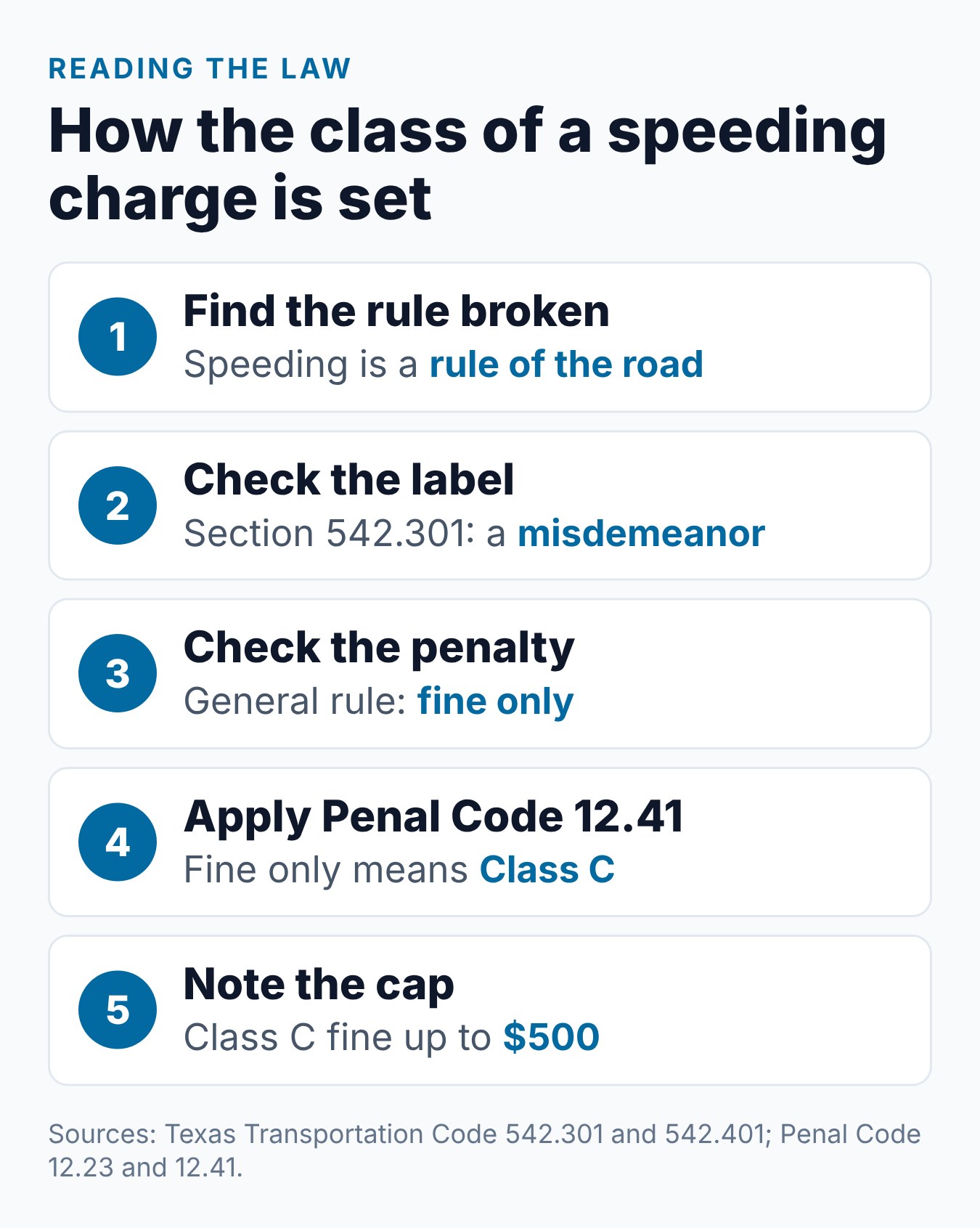
Speeding is one of the rules of the road in Transportation Code Title 7, Subtitle C. Section 542.301 of Transportation Code Chapter 542 says a person who breaks one of those rules commits an offense, and that it is a misdemeanor.
So a speeding ticket is not a civil matter in Texas. It is a misdemeanor offense, handled under the Code of Criminal Procedure. That is why the case moves through pleas and ends in a judgment or a dismissal.
How Texas Sets the Class
The class comes from the penalty. Chapter 542 sets a general fine of $1 to $200 when no other penalty applies, and it sets only a fine for that offense.
The Texas Penal Code then sorts offenses by class. Section 12.41 in Penal Code Chapter 12 says an offense outside the Penal Code that is punishable by fine only is a Class C misdemeanor. A speeding offense under the general fine rule fits that test.
The Three Misdemeanor Classes
Penal Code Section 12.03 sorts misdemeanors into Class A, Class B and Class C, based on how serious they are. Each class has its own penalty limits.
| Class | Highest fine | Jail term in the statute |
|---|---|---|
| Class A | Up to $4,000 | Up to one year |
| Class B | Up to $2,000 | Up to 180 days |
| Class C | Up to $500 | None listed |
Class C is the only class punished by a fine alone. The general traffic range in Chapter 542 tops out at $200, well below the $500 Class C cap.
How a Speeding Charge Starts
Transportation Code Chapter 543 shapes the roadside part. For speeding, the officer must issue a written notice to appear if you sign a written promise to appear. You are then released.
The law lists speeding among the few offenses where this written notice is mandatory. That is why a standard speeding stop ends with a citation and not a trip to jail.
The promise has teeth, though. A person who wilfully breaks a written promise to appear commits a separate misdemeanor. That holds no matter how the speeding charge ends.
Which Courts Hear Class C Cases
Class C traffic cases go to a justice court or a municipal court. Code of Criminal Procedure Chapter 45A sets the rules for both.
Each court has its own prosecutor. Chapter 45A says a county or district attorney handles each prosecution in a justice court. A municipal attorney handles each one in a municipal court.
The court named on your citation is the one that handles your case. It sets the fine within the law and decides the case.
When Driving Offenses Are More Serious
Not every driving offense is Class C. Some carry jail terms and sit in higher classes:
- DWI: a basic driving while intoxicated charge is a Class B misdemeanor under Penal Code Section 49.04, with at least 72 hours in jail.
- Racing on a highway: Transportation Code Section 545.420 makes it a Class B misdemeanor.
These are separate offenses with their own rules. A routine speeding ticket under the general fine rule is not one of them. If your citation names a different offense, ask a lawyer what class it is.
Pleas in a Class C Case
A Class C case begins with a plea. Chapter 45A gives three choices: guilty, not guilty, or nolo contendere, which means no contest. A plea may be oral or in writing, as the court directs.
If a defendant refuses to plead, the judge must enter a plea of not guilty. You also have the right to appear through a lawyer, and you may waive a jury in writing.
This article does not tell you which plea to enter. Talk to a lawyer about that choice.
Missing a Court Date
A Class C case can still lead to an arrest warrant in some cases. Chapter 45A limits when a judge may issue one for missing the first court setting. The limits depend on notice rules set out in the statute.
The law also helps a driver who comes forward. A judge must recall a warrant for failure to appear if the person appears on their own and makes a good faith effort to resolve it. The simplest step is to respond by the answer date.
Drivers Under 25
Chapter 45A has two rules for younger drivers. For a driver under 25, the course rules cover any moving violation in a justice or municipal court that involves driving a motor vehicle.
If a judge defers the case of a driver under 25 for a moving violation, the judge must require a driving safety course. A provisional license holder must also take a DPS exam.
What a Conviction Means for Your Driving Record
Paying the ticket counts as a plea of guilty or no contest. The case ends in a conviction. Chapter 543 says the court must report it to Texas DPS no later than the seventh day after the conviction.
DPS keeps that conviction on your driving record. Under Transportation Code Chapter 521, your own record can list each reported traffic violation and crash.
Too many convictions can lead to a suspension. DPS must suspend the license of a habitual violator.
That means 4 or more moving-violation convictions in 12 months, or 7 or more in 24 months. For more on what DPS keeps, see the Texas DPS driving record guide.
The Criminal Record Question
A speeding conviction is a Class C misdemeanor conviction. Whether it shows up on a given background check, or how a reviewer treats it, is not something we could confirm from an official source.
The rules differ by who is checking and why. If this matters for a job, a license or school, talk to a lawyer about your own situation. They can explain how a Class C conviction may be viewed.
How a Course Dismissal Changes the Outcome
The driving safety course gives eligible drivers another ending. You plead guilty or no contest and ask for the course on or before the answer date. You then have 90 days to finish the course and turn in your papers.
When you do, the court removes the judgment and dismisses the charge. Chapter 45A says a dismissed charge “may not be part of a person’s driving record or used for any purpose.” Your record can show that you took a course, but not why.
The course right has limits. It is not open to CDL holders, or for 25 mph or more over the limit or 95 mph or more. For how a dismissal compares with paying, read does defensive driving dismiss a ticket or keep it off your record.
Deferred Disposition
Deferred disposition is a separate path that the judge controls. If you meet the judge’s conditions, the judge dismisses the complaint. The docket shows the dismissal and that there is no final conviction.
Questions to Bring to a Lawyer
A short consult can clear up what a conviction means for you. These questions can help you use the time well:
- What class is the offense on my citation?
- Do I qualify for the driving safety course or deferred disposition?
- How could a conviction affect a job, a license or school plans?
- What deadlines apply to my case?
Bring your citation and any letters from the court. Note the answer date before the meeting.
Facts at a Glance
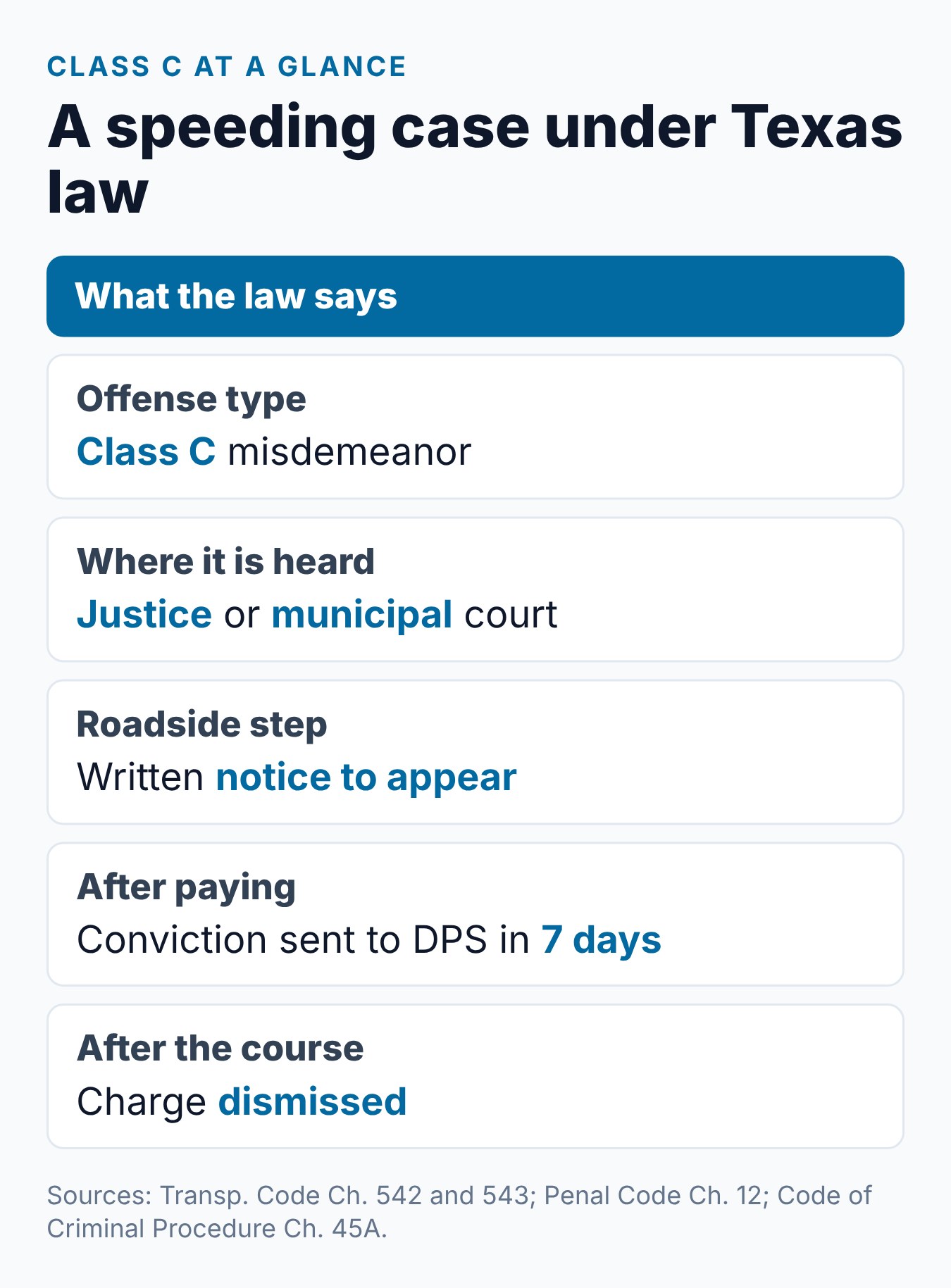
The card below pulls the key rules into one view. Each line comes from the Transportation Code, the Penal Code or Chapter 45A.
What We Found in the Penal Code
On the Legislature’s compiled Penal Code Chapter 12 we checked on October 26, 2026, Section 12.23 still capped a Class C fine at $500. Section 12.41 still classed a fine-only offense outside the Penal Code as Class C.
None of those sections showed a 2025 change. Their latest history notes were from 2009 or earlier.
Common Mistakes to Avoid
These follow from the rules above:
- Calling it a civil fine. Texas law makes speeding a misdemeanor.
- Assuming paying is not a plea. Paying is a plea of guilty or no contest, and it ends in a conviction.
- Skipping court. Wilfully breaking a promise to appear is its own misdemeanor.
- Mixing up classes. DWI and highway racing are Class B, not Class C.
- Guessing about background checks. Ask a lawyer how a conviction may be viewed in your case.
How Requirements Can Vary
The driving safety course rules come from Texas law and TDLR and apply statewide. Each justice or municipal court still sets its own fees, filing steps and contact methods, and the facts of your citation decide which options you have.
Laws, fees and court procedures can change. Check your citation, ask the court that handles your case, and use the TDLR and Texas DPS websites for current rules before you act.
Frequently Asked Questions
Is a speeding ticket a misdemeanor in Texas?
Yes. Texas law makes breaking a rule of the road a misdemeanor. A speeding offense punished by fine only is a Class C misdemeanor.
Can I go to jail for a speeding ticket in Texas?
The Class C penalty in the Penal Code is a fine of up to $500, with no jail term listed. Other offenses, such as DWI, carry jail time and are in a higher class.
Does a Texas traffic ticket give me a criminal record?
A paid ticket is a Class C misdemeanor conviction. We did not find an official source on how background checks treat it, so ask a lawyer about your situation.
What court handles a Class C speeding ticket?
A justice court or a municipal court. The court on your citation handles your case.
Is paying the ticket the same as pleading guilty?
Paying means a plea of guilty or no contest. Both lead to a conviction that the court reports to Texas DPS.
Does the driving safety course remove the conviction?
The course path ends in a dismissal, not a conviction. A charge dismissed this way may not be part of your driving record. It cannot remove a conviction you already have.
What happens if I refuse to plead?
Chapter 45A says the judge must enter a plea of not guilty for you. The case then moves toward a trial.
Can a Class C traffic fine be more than $200?
The general traffic range is $1 to $200, but another law can set a different penalty. Work-zone fines double when workers are present. The Penal Code caps a Class C fine at $500.
Conclusion
A Texas speeding ticket is a Class C misdemeanor, punished by a fine only. Paying it ends in a conviction that goes to Texas DPS, while a course dismissal keeps the charge off your driving record.
For questions about criminal records, a lawyer can help. If you qualify, Driving Logic’s online Texas driving safety course is one way to take the course.
Related Articles
- Texas Speeding Ticket: Costs, Record Impact, and What to Know
- Texas Speeding Ticket Options: Pay, Contest, or Take Defensive Driving
- Does Texas Defensive Driving Dismiss a Ticket or Keep It Off Your Record?
- Texas DPS Driving Record: What TxDPS Tracks and Why It Matters
Sources
- Texas Transportation Code Chapter 542 — Rules of the Road, General Provisions (PDF)
- Texas Transportation Code Chapter 543 — Arrest and Prosecution of Violators (PDF)
- Texas Code of Criminal Procedure Chapter 45A (PDF)
- Texas Transportation Code Chapter 521 — Driver’s Licenses (PDF)
- Texas Transportation Code Chapter 545 — Operation and Movement of Vehicles (PDF)
Billy Forte is the owner of Driving Logic, a state-approved driver improvement course provider serving Texas and other U.S. states.
This article is general information, not legal advice. Texas traffic and driving safety course rules are set by Texas law, TDLR, Texas DPS and each court, and they can change. Check with the court on your citation and the official TDLR and DPS websites for current requirements, and talk to a Texas lawyer about your specific case.