
Updated October 2026 · Reviewed by Billy Forte
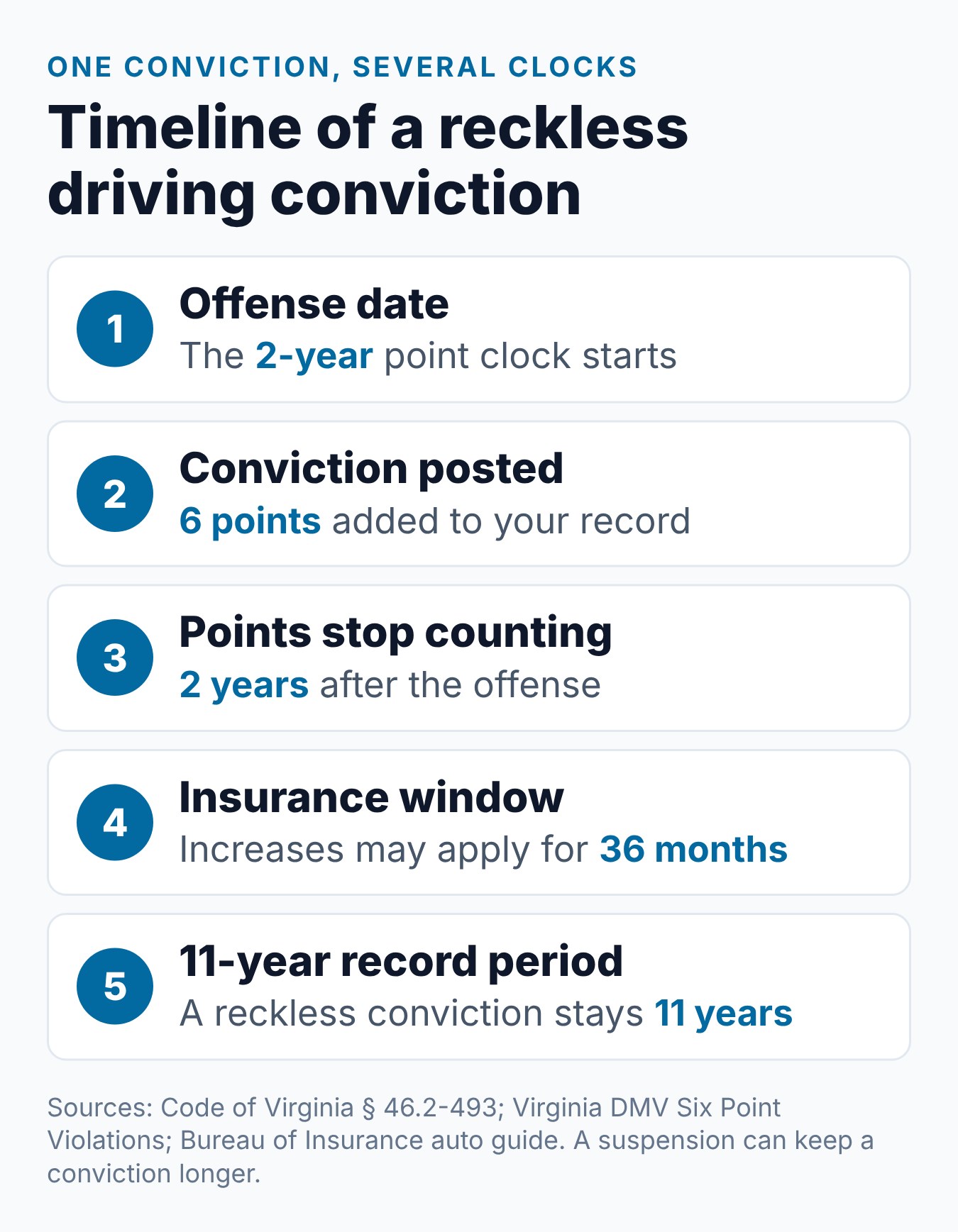
If you searched how long does reckless driving stay on record in va, the answer is 11 years on your Virginia DMV driving record. Other violations stay for different periods: speeding stays 5 years, and many other 3- and 4-point violations stay 3 years. The demerit points from any of them count for only 2 years from the offense date.
Key Facts
- Reckless driving: every reckless driving entry on DMV’s lists stays 11 years. See reckless driving.
- Speeding: speeding convictions stay 5 years at every speed tier, when the conviction is speeding and not reckless driving. See the retention table.
- Per violation: DMV sets the period for each violation, not by point level. See why it varies.
- Points are separate: demerit points count 2 years from the offense date. See points and records.
- Insurance: increases for violations “may be applied for 36 months.” See insurance.
How Long Does Reckless Driving Stay on Record in VA?
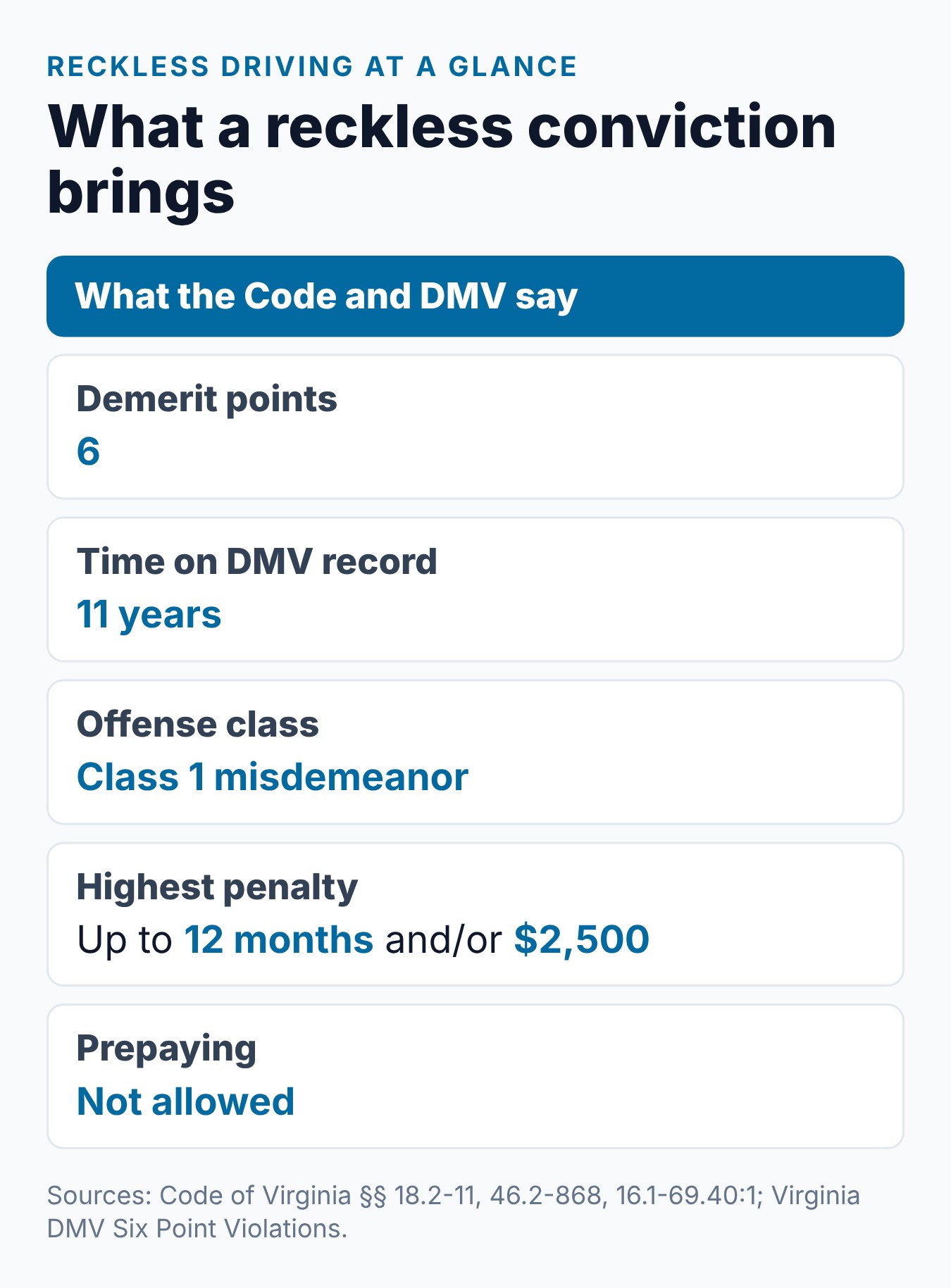
Reckless driving stays on your Virginia DMV record for 11 years. DMV’s Six Point Violations page lists each reckless driving entry with “(11 years)” beside it.
These reckless driving entries all carry 6 points and stay 11 years:
- Speeding in excess of 85 mph.
- Speeding 20 mph or more above the posted speed limit.
- Racing.
- Passing a school bus.
- Passing on the crest of a hill.
- Driving too fast for conditions.
- Failing to give a proper signal.
- Faulty brakes or improper control.
- Reckless driving in general.
One reckless entry is on the four-point list. DMV’s Four Point Violations page lists “Reckless driving – failure to stop before entering a highway (11 years).” It carries 4 points, but it still stays 11 years.
What Makes Speeding Reckless Driving
Speed alone can make a charge reckless driving. Code of Virginia § 46.2-862 covers driving “at a speed of 20 miles per hour or more in excess of the applicable maximum speed limit.” It also covers driving “in excess of 85 miles per hour regardless of the applicable maximum speed limit.”
DMV also lists a separate, non-reckless entry for speeding 20 mph or more over. That entry carries 6 points but stays 5 years.
So the type of conviction decides the time, not just the speed. Our guide on when speeding becomes reckless driving covers the speed line.
Retention by Violation
DMV’s point lists show the years in parentheses beside each violation. This table pulls examples from the three lists.
| Violation, as DMV lists it | Points | Years it stays |
|---|---|---|
| Reckless driving, speeding 20 mph or more over | 6 | 11 |
| Reckless driving, speeding in excess of 85 mph | 6 | 11 |
| Reckless driving, failure to stop before entering a highway | 4 | 11 |
| Speeding 20 mph or more over (non-reckless entry) | 6 | 5 |
| Speeding 10-19 mph over | 4 | 5 |
| Speeding 1-9 mph over | 3 | 5 |
| Aggressive driving | 4 | 5 |
| Driving while intoxicated | 6 | 11 |
| Driving after illegally consuming alcohol, under 21 | 6 | 3 |
| Failure to yield right-of-way | 4 | 3 |
| Improper passing | 3 | 3 |
| Use of handheld communications device | 3 | 3 |
DMV’s Three Point Violations page holds the 3-point entries. DMV warns that “The violations listed may change without notice.”
Retention Is Set per Violation
The table shows a key rule. Time on the record does not follow the point level.
A 6-point entry can stay 3, 5 or 11 years. A 4-point entry can stay 3, 5 or 11 years.
That means you cannot guess the period from the points alone. Find your exact violation on DMV’s list and read the years beside it.
Other 11-Year and Permanent Entries
Reckless driving is not the only 11-year entry. DMV’s six-point list also gives 11 years for these:
- Driving while intoxicated.
- Driving on a suspended license, or while your license is suspended or revoked.
- Manslaughter.
- Failure to stop at the scene of a crash with injury, death, or property damage of $1000 or more.
Some entries never leave. DMV says an asterisk “indicates that the conviction remains on your record permanently.” Several commercial-vehicle DUI entries carry that mark.
When Convictions Stay Longer
The listed years are not always the end. DMV’s Moving Violations and Point Assessments page says a revocation, suspension, disqualification or cancellation means “your convictions could remain on your record for even longer than specified in one of these lists.”
DMV’s lists also do not say which date starts the count. They give the number of years but not whether it runs from the offense date or the conviction date. Ask DMV if the exact end date matters for you.
Points and Record Time Are Separate
Demerit points follow their own clock. Code § 46.2-493 says points are “valid for a period of two years from the date the offense was committed.”
So a reckless driving conviction carries 6 points that count for 2 years. The conviction itself stays 11 years. DMV says point dates “are not related to the dates that convictions are removed from your record.”
Points can last longer in one case. If DMV used them for a suspension, probation or other action, they stay valid until that action ends. Our guide on how long points stay explains the 2-year rule.
Reckless Driving and DMV Point Limits
A reckless driving conviction adds 6 points at once. That can move a driver close to a DMV action. For drivers 18 and over, the levels are:
- 8 points in 12 months or 12 in 24: DMV may send an advisory letter.
- 12 in 12 or 18 in 24: DMV orders a Driver Improvement Clinic.
- 18 in 12 or 24 in 24: a 90-day suspension plus the clinic, or 9 months in the Intelligent Speed Assistance Program plus the clinic.
Drivers aged 18 and 19 must take a clinic after any demerit-point conviction. Under 18, DMV acts by the number of convictions, not point totals. Our points system guide shows each step.
Reckless Driving in Court
The DMV record is only one part of a reckless driving case. Code § 46.2-868 makes reckless driving a Class 1 misdemeanor. Under Code § 18.2-11, that means up to 12 months in jail and/or a fine up to $2,500.
There are more court rules:
- No prepaying. Reckless driving cannot be prepaid under Code § 16.1-69.40:1.
- License suspension. A court may suspend the license for up to 6 months, under Code § 46.2-392, or order the Intelligent Speed Assistance Program instead.
- Over 100 mph. Under Code § 46.2-393, the court must order one of these.
This guide covers the DMV record only, not court records. For your own case, talk with the court or a Virginia attorney. Our guide on reckless driving and the clinic covers the penalties.
Insurance and Your Record
Insurance follows a different clock again. Virginia’s Bureau of Insurance auto insurance guide says, “Premium increases due to accidents or violations may be applied for 36 months.”
DMV’s insurance record also has its own lookback. The insurance summary covers up to 5 years. Insurance company points are set by each company and are not DMV demerit points.
Which Records Show It
The record type you order sets how far back it looks. DMV’s record request page lists these lookbacks:
- Personal use: up to 11 years.
- Employment, school or military: up to 7 years, with your signed release.
- Insurance summary: up to 5 years.
A driving record costs $9, or $8 online. Order your personal record to see every entry and its date.
How to Check Your Own Dates
You can work out your own dates from official sources. Follow these steps in order:
- Order your personal record. It looks back up to 11 years.
- List each conviction. Note the violation name and the dates shown.
- Find it on DMV’s lists. Read the years in parentheses beside it.
- Check for suspensions. A suspension or revocation can keep convictions longer.
- Count the points separately. They count 2 years from the offense date.
If an entry does not match your court papers, see our guide on disputing a record error.
What a Clinic Can and Cannot Change
A Driver Improvement Clinic does not shorten the time a conviction stays on your record. A reckless driving conviction still stays 11 years after you finish a clinic.
What a clinic can do is lower your point total. An eligible clinic earns 5 safe driving points, once every 24 months. For a court-ordered clinic, the court decides whether you get those points.
What We Found on the Official Pages
On the official pages we checked on October 27, 2026, every reckless driving entry on DMV’s six-point list still showed 11 years. The non-reckless entry for speeding 20 mph or more over still showed 5 years.
The Moving Violations page still said point dates and conviction dates are not related. None of the three lists said which date starts the count.
Common Mistakes
Each item below comes from a Virginia DMV page or the Code:
- Guessing time from points. DMV sets the period per violation.
- Mixing up the two 20-over entries. Reckless driving stays 11 years; the non-reckless speeding entry stays 5.
- Thinking points last as long as the conviction. Points count 2 years from the offense.
- Forgetting suspensions. They can keep convictions on the record longer.
- Expecting a clinic to shorten the period. The conviction stays its full time.
- Planning to prepay a reckless charge. The Code does not allow it.
How Requirements Can Vary
Virginia’s point rules, safe driving points and DMV clinic orders come from the Code of Virginia and DMV rules, and they apply statewide. What you must do still depends on whether you take the clinic by choice, because of a DMV notice, or under a court order. A court order sets its own deadline and proof steps.
Laws, fees and court practice can change. Check your DMV notice, your court order and the Virginia DMV website for current rules before you enroll or file anything.
Frequently Asked Questions
How long does reckless driving stay on your record in Virginia?
It stays 11 years on your Virginia DMV driving record. Every reckless driving entry on DMV’s lists shows 11 years. A suspension or revocation can keep it on the record longer.
How long does a speeding ticket stay on a Virginia record?
A speeding conviction stays 5 years. That is true for 1-9, 10-19 and 20 or more mph over, when the conviction is speeding and not reckless driving.
How long do other violations stay?
It depends on the violation. Many other 3- and 4-point violations stay 3 years. DWI and driving while suspended stay 11 years, and some commercial-vehicle DUI entries stay permanently.
Do reckless driving points last 11 years too?
No. The 6 demerit points count for 2 years from the offense date. The conviction stays on the record for 11 years.
Does the 11 years start at the offense or the conviction?
DMV’s lists do not say. They give the number of years only. Ask DMV if you need the exact end date.
Can a Driver Improvement Clinic shorten the time?
No. The conviction stays for its full listed period. An eligible clinic can lower your point total by 5, once every 24 months.
Do convictions from other states count in Virginia?
Yes, for points. DMV says demerit points are also assigned to your record for traffic convictions in other states. Check your Virginia record to see how each one is listed.
How long can insurance rates stay higher?
The Bureau of Insurance says premium increases for violations may be applied for 36 months. Ask your insurer how it treats your record.
Conclusion
Reckless driving stays on your Virginia DMV record for 11 years, while speeding stays 5 years and many other 3- and 4-point violations stay 3 years. The points from each one count for only 2 years. Take the Virginia Driver Improvement Course to earn the 5-point credit if you are eligible. If a court ordered your clinic, ask the court whether it accepts an online course.
Related Articles
- Virginia DMV Points System Explained
- How Long Do Points Stay on Your License in VA?
- How Long Does a Speeding Ticket Stay on Your Record in Virginia?
- Reckless Driving in VA: Penalties, Points and the Clinic
Sources
- Virginia DMV — Six Point Violations
- Virginia DMV — Four Point Violations
- Virginia DMV — Three Point Violations
- Virginia DMV — Moving Violations and Point Assessments
- Virginia DMV — Request a Copy of Your Driver or Vehicle Record
- Code of Virginia § 46.2-493 — Demerit points valid for two years
- Code of Virginia § 46.2-862 — Exceeding speed limit (reckless)
- Code of Virginia § 46.2-868 — Reckless driving; penalties
- Code of Virginia § 18.2-11 — Punishment for misdemeanors
- Code of Virginia § 46.2-392 — License suspension on conviction
- Code of Virginia § 46.2-393 — License suspension for reckless offenses
- Code of Virginia § 16.1-69.40:1 — Traffic infractions, prepayment
- Virginia Bureau of Insurance — Consumer’s Guide for Auto Insurance
Billy Forte is the owner of Driving Logic, a state-approved driver improvement course provider serving Virginia and other U.S. states.
This article is general information, not legal advice. Virginia DMV rules, court orders, fines and penalties depend on your notice, summons, court and case facts, and they can change. Use official Virginia DMV and court sources, and consult a qualified Virginia attorney for advice about your own case.