
Updated October 2026 · Reviewed by Billy Forte
Indiana online driver safety courses are legitimate when the provider is on the Indiana BMV’s approved Driver Safety Program (DSP) list, because the BMV says the curriculum is “available in a classroom, DVD or online format.” An approved online course follows the same curriculum standards as every other format and earns the same 4-point credit. The risk is not the online format itself but a site that is not on the list or that pretends to be the BMV.
Key Facts
- Online is allowed: the BMV lists online as one of three DSP formats. See why an online course can count.
- The test of legitimacy: the provider’s name appears on the BMV’s approved list. See what makes a course legit.
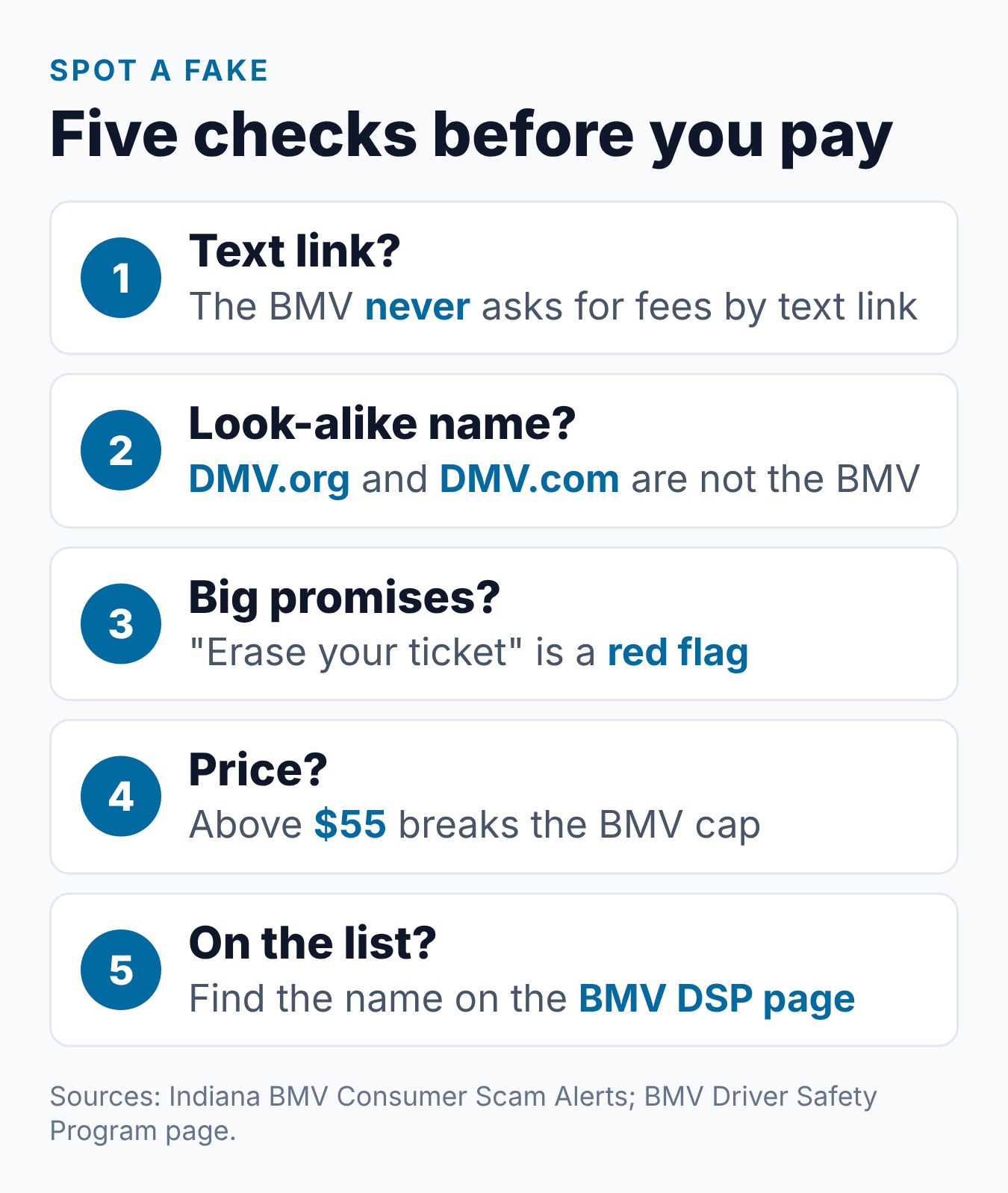
- Red flags: not on the list, over $55, under 4 hours, or promises to erase tickets. See warning signs.
- Look-alike sites: the BMV names fake sites that are “not affiliated with the Indiana BMV in any way.” See look-alike sites.
- Limits of a legit course: it earns a credit; it does not remove the citation. See what legit does not mean.
Why an Online Course Can Count
The answer starts on the BMV’s own Driver Safety Program page. It says DSP curriculum “is available in a classroom, DVD or online format.” Online is one of the listed formats, not an exception.
The same page holds every course to one bar: shared curriculum standards, a four-hour minimum, and versions in English and Spanish. An approved online course must clear that same bar.
The credit follows the provider, not the format. The credit rule at 140 IAC 1-4.5-7 grants 4 points to anyone who completes a BMV-approved program, entered once every three years. Nothing in that rule treats an online course differently.
What Makes a Course Legit
For BMV purposes, one fact decides it: is the provider on the BMV’s approved list? The BMV’s FAQ asks, “Can I use any Driver Safety Program vendor?” Its answer is “No.”
The BMV explains that credit can be applied to your record “only if the course was completed by a BMV-approved Driver Safety (DSP) Program Provider.” A course from a provider that is not on the list does not earn the credit, however polished the site looks.
The BMV also tells drivers how to sign up. Its page says to call or email the provider directly, using the contact details on the list. For a full walk-through of that check, see how to verify BMV approval.
Indiana Online Driver Safety Warning Signs
Indiana online driver safety sites should match the BMV’s rules. Each warning sign below conflicts with something the BMV says:
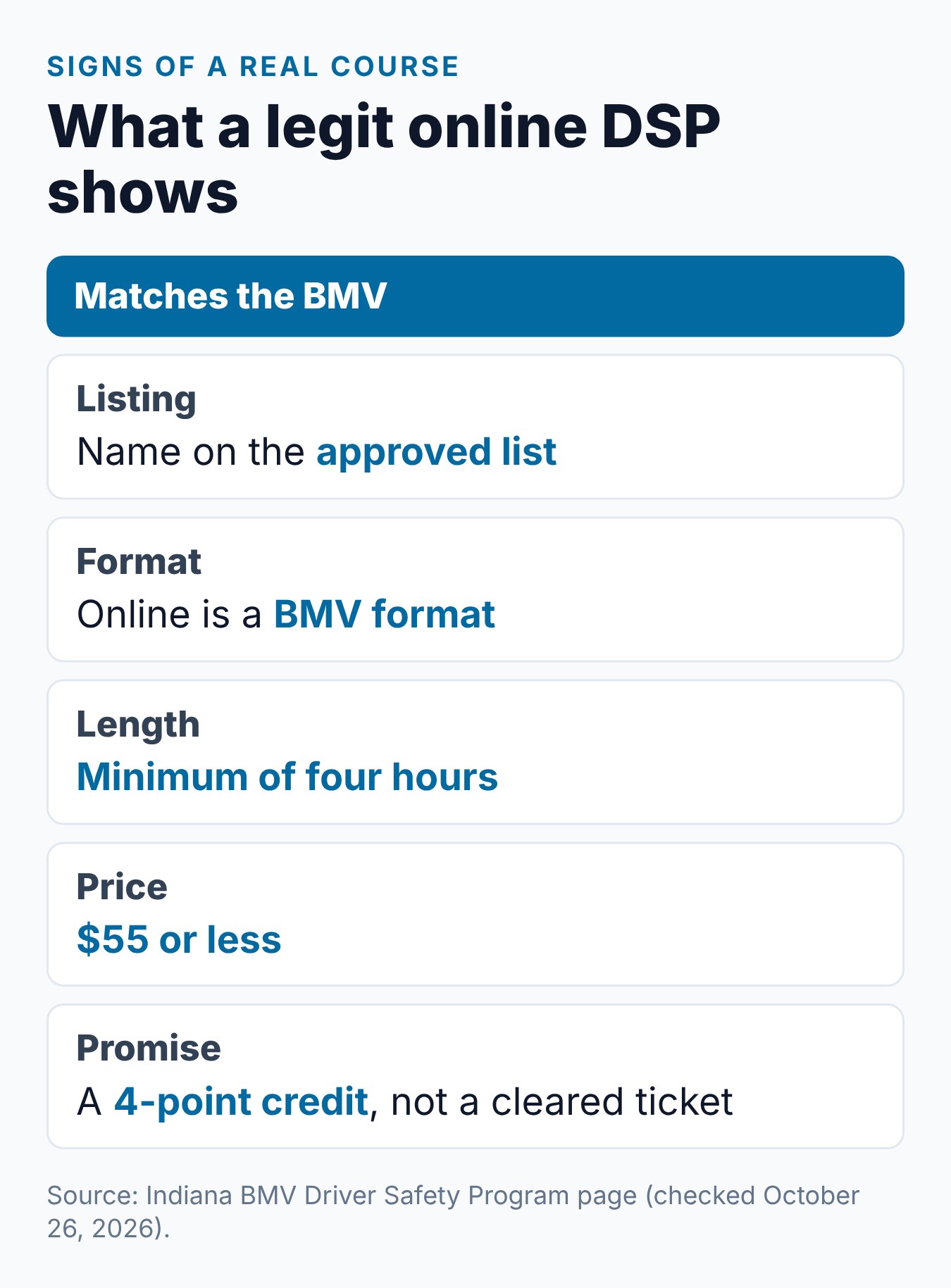
- The provider is not on the list. Only approved providers earn the credit.
- The price is above $55. The BMV says the maximum cost for any approved course is $55.
- It promises less than 4 hours. Every approved course is “a minimum of four hours.”
- It promises to erase tickets or remove points. The BMV says completion “will not remove a citation from your driver history.”
- It claims to be the BMV. The BMV names fake look-alike sites on its scam page.
- It sends a text link that claims to be from the BMV. The BMV says it will “NEVER” ask for fees through a text link.
One sign alone may not prove a scam. But any of them is a reason to stop and check the BMV’s list before you pay.
What the Approved List Shows
The BMV’s list is more than a set of names. Each listing gives the provider’s name, contact details and the formats it offers. That lets you compare a site you found with what the BMV published.
Check that the provider name and web address you see match the BMV’s listing. If the names are close but not the same, go back to the BMV page and use the listed contact details instead.
Why the Price Cap Helps
The BMV sets one price rule for all approved courses. It says, “The maximum cost for any of the BMV-approved DSP courses is $55.” It also says all drivers taking a DSP must pay any fees for the course.
So a course priced above $55 does not fit the BMV’s rule. Prices at or below the cap vary by provider, and the BMV does not rank them.
Look-Alike Sites the BMV Names
The BMV keeps a Consumer Scam Alerts page. It lists sites that look official but are not. Among them are www.in-bmv.cfd, www.visitmybmv.com, www.DMV.org and www.DMV.com.
The BMV says these sites are “not affiliated with the Indiana BMV in any way and may contain malicious content.” A course link from a site like these is not a link from the BMV.
The same page gives the BMV’s own channels. It says BMV transactions happen only through IN.gov/mybmv or myBMV.com, or at a branch. Its call center number is 888-692-6841.
Texts and Links That Claim to Be the BMV
Scam texts are a separate risk from course sites, but they can overlap. The BMV says it will “NEVER ask you to pay any fees through a link sent via a text message.”
So a text that pushes you to pay for a “required” course through a link should raise a flag. Real BMV DSP requirements are mailed. For more on fake “final notice” texts, see BMV final notice scams.
Legit Course vs. Warning Sign
This table puts the BMV’s rules next to the signs that break them:
| What to check | A legit approved course | A warning sign |
|---|---|---|
| Provider | Named on the BMV’s DSP list | Missing from the list |
| Price | $55 or less | More than $55 |
| Course time | At least 4 hours | Promises fewer hours |
| What it offers | A 4-point credit; the citation stays | “Erase” or “remove” your ticket |
| How you sign up | Directly with the listed provider | A text link or a BMV look-alike site |
| Language | English or Spanish | Not offered as the BMV requires |
What Legit Does Not Mean
A legitimate course has real limits, and knowing them prevents surprises.
- It does not remove the ticket. The BMV says completion “will not remove a citation from your driver history.”
- It earns one credit per three years. The credit can be entered only once every three years. Another course inside that period extends it from the new date.
- It does not set a court’s rules. The BMV says a court order may not require a BMV-approved DSP. The court’s order sets its own deadline and proof steps.
So “legit” means legit for the BMV credit. If a court ordered your course, read the order before you choose a format. See court-ordered DSP online for that question.
How Completion Reaches the BMV
With an approved provider, you do not file anything with the BMV yourself in the normal case. The provider sends the completion report. From the day the BMV gets it, the BMV allows 7 to 14 business days to apply the credit.
If the credit has not shown up after that time, the BMV says to email your completion certificate to BMVDSP@bmv.IN.gov. You can check your record on myBMV, where the Viewable Driver Record is free.
Questions to Ask Before You Pay
A real provider should answer these plainly:
- What name are you listed under on the BMV’s DSP page?
- Which formats do you offer: online, DVD or classroom?
- Can I take the course in English or Spanish?
- What is the full price of the course?
- How will I get my completion certificate?
If the answers do not match the BMV’s listing, use the contact details on the BMV page instead.
If a BMV Notice Sent You
A real BMV notice comes by mail. IC 9-30-3-12 requires a course after a driver’s moving violations within 12 months produce two traffic misdemeanor convictions, two traffic judgments, or one of each.
The course must be done within 90 days of the notice, or driving privileges are suspended. With that deadline, a course from an unlisted provider is a costly mistake. It would not count as the BMV-approved course the law requires.
Format Choices on the List
Online is not the only legitimate choice. The BMV allows classroom, DVD and online formats, and each provider’s listing shows which ones it offers. See online, DVD or classroom for how the formats compare.
Whichever format you pick, sign up with a provider whose BMV listing shows that format. The credit rule is the same for all three.
What We Found on the Official Pages
As of our October 26, 2026 check, the Driver Safety Program page listed 17 approved providers.
The BMV’s scam alerts page named in-bmv.cfd, visitmybmv.com, DMV.org and DMV.com as sites not affiliated with the BMV. It also said the BMV will never ask for fees through a text link.
Common Mistakes to Avoid
Each item comes from a BMV page or an Indiana rule:
- Trusting a site because it looks official. The BMV names look-alike sites that are not affiliated with it.
- Skipping the list check. Only courses from BMV-approved providers earn the credit.
- Paying more than $55. That is the BMV’s maximum for any approved course.
- Believing a ticket will vanish. The citation stays on your driver history.
- Paying a “BMV” text link. The BMV says it never asks for fees that way.
- Assuming online fits every court order. The court’s order sets its own terms.
How Requirements Can Vary
Indiana’s point rules, the 4-point credit and the BMV’s Driver Safety Program order come from state law and BMV rules, and they apply statewide. What you must do still depends on whether you take the course by choice, because of a BMV notice, or under a court order. A court order sets its own deadline and proof steps.
Laws, fees and court practice can change. Check your BMV notice, your court order and the Indiana BMV website for current rules before you enroll or file anything.
Frequently Asked Questions
Is the Indiana Driver Safety Program online legit?
Yes, when the provider is on the BMV’s approved list. The BMV says DSP curriculum is available online, and approved online courses earn the same 4-point credit as other formats.
Does the BMV accept online courses for the 4-point credit?
Yes, from approved providers. The BMV says credit applies only if the course came from a BMV-approved provider, and it lists online as a format.
How do I know a course site is real?
Find the provider’s name on the BMV’s Driver Safety Program page and sign up with that provider directly. Check that the price is $55 or less.
Is DMV.org the Indiana BMV?
No. The BMV’s scam page says DMV.org and DMV.com are “not affiliated with the Indiana BMV in any way.”
Can an online course remove my ticket?
No. The BMV says completion “will not remove a citation from your driver history.” An approved course earns a 4-point credit instead.
Is an online course shorter than a classroom course?
No. The BMV says all approved courses are a minimum of four hours, whatever the format. A site that promises less does not match the BMV’s rule.
What if I already took a course from an unlisted site?
The BMV says credit applies only to courses from approved providers. If you have a BMV notice, finish a course from a listed provider within the 90 days.
If a court ordered it, ask the court whether the course meets its order. If a site claimed to be the BMV, the scam page lists the BMV call center at 888-692-6841.
Conclusion
An Indiana online driver safety course is legitimate when its provider is on the BMV’s approved list, and it earns the same credit as any other format. Check the list, keep the price at $55 or less, and avoid sites that imitate the BMV.
To start, see Driving Logic’s online Indiana Driver Safety Program. If a court ordered your course, check that the order allows an online course.
Related Articles
- Indiana Driver Safety Program: The Complete Guide
- Indiana BMV-Approved Driver Safety Program: What It Means and How to Verify
- Indiana BMV Driver Safety Class: Online, DVD or Classroom
- Indiana BMV Text Scam: How to Spot a Fake “Final Notice”
Sources
- Indiana BMV — Citation Points & Driver Safety Program
- Indiana BMV — Consumer Scam Alerts
- 140 IAC 1-4.5 — BMV point system rules
- Indiana Code § 9-30-3-12 — Driver safety program
- Indiana BMV — myBMV
Billy Forte is the owner of Driving Logic, a state-approved driver improvement course provider serving Indiana and other U.S. states.
This article is general information, not legal advice. Indiana BMV rules, court orders, fines and penalties depend on your notice, citation, court and case facts, and they can change. Use official Indiana BMV and court sources, and consult a qualified Indiana attorney for advice about your own case.