
Updated October 2026 · Reviewed by Billy Forte
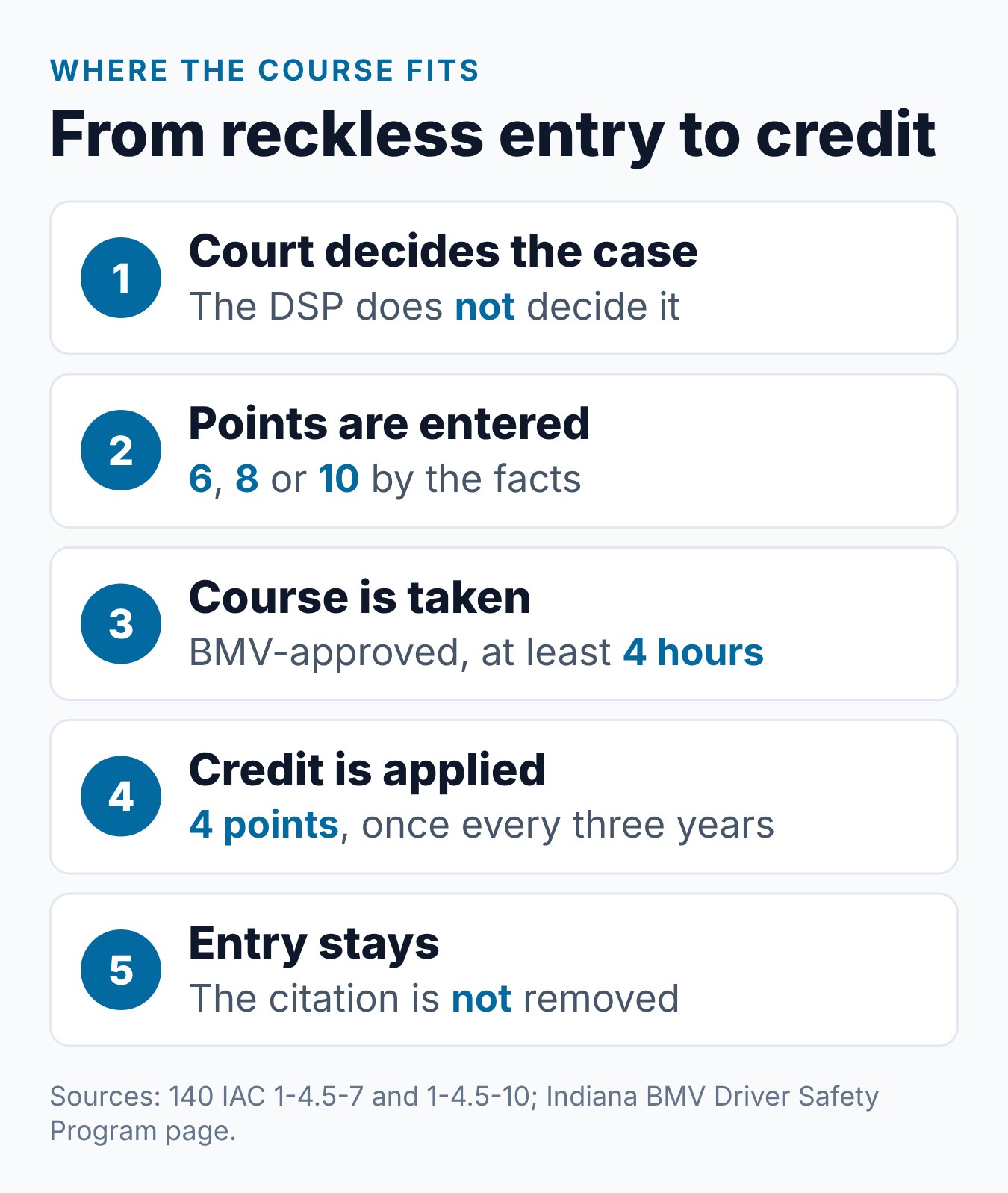
For driver safety program reckless driving Indiana questions, the short answer is that a BMV-approved Driver Safety Program (DSP) adds a 4-point credit to your record, once every three years, but it is not a defense to a reckless driving charge. Reckless driving carries 6 points, or 8 with property damage and 10 with bodily injury, so the credit offsets only part of them. The court decides the criminal case, and the course does not remove the citation.
Key Facts
- Points: reckless driving is 6 points, 8 with property damage, 10 with bodily injury. See reckless driving points.
- The credit: a BMV-approved DSP adds a 4-point credit, once every three years. See the credit math.
- Not a defense: the course does not decide or end the criminal case. See not a defense.
- Court orders: a court may order a DSP and may suspend half of the court costs. See when a court orders it.
- BMV orders: a reckless conviction can count toward a BMV-ordered DSP. See when the BMV orders it.
Driver Safety Program Reckless Driving Indiana Basics
The DSP works on your BMV point total. It does not work on the criminal case. Here is the split, based on BMV and Indiana sources:
What it can do:
- Add a 4-point credit to your Official Driver Record, if the course is BMV-approved.
- Count toward a court requirement, if the court orders or accepts it.
- Meet a BMV order to take the course.
What it cannot do:
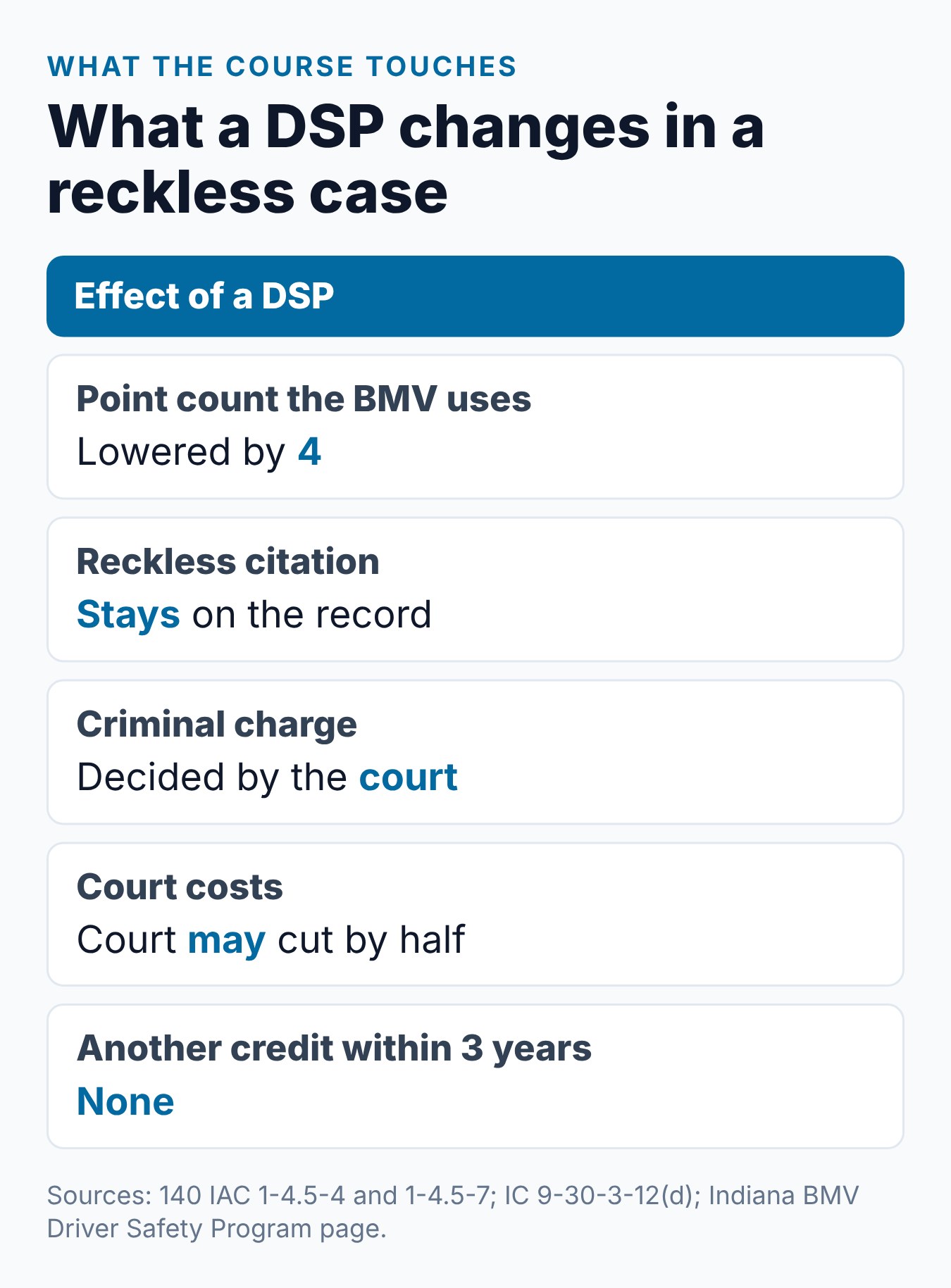
- Remove the citation. The BMV says completion “will not remove a citation from your driver history.”
- Change the charge or decide guilt. Only the court does that.
- Earn a second credit within three years.
Three Separate Tracks
A reckless driving case touches three systems. Each one has its own rules:
- The criminal case. A court decides it under IC 9-21-8-52. The result depends on the facts and the court.
- BMV points. The BMV enters points from the court’s record under 140 IAC 1-4.5-10.
- The DSP credit. The BMV applies a 4-point credit for a BMV-approved course under 140 IAC 1-4.5-7.
The DSP touches only the third track directly. It lowers the count used on the second track. It does not reach the first.
Reckless Driving Points
The BMV’s point values are in 140 IAC 1-4.5-10. For reckless driving, the table gives 6 points for the base offense. It gives 8 points with damage to property and 10 points with bodily injury.
Related entries carry 8 points each. These include reckless operation in a highway work zone, reckless driving in a tractor-trailer combination, and passing a stopped school bus with the arm signal out.
Two rule details matter. Property damage or injury “shall not be presumed” for points unless the court’s record says so. And the point value comes from the table in effect on the date of the violation.
How the Credit Math Works
The credit lowers the count the BMV uses for its point steps. Under 140 IAC 1-4.5-4, warnings and suspensions are based on active points “after any credit earned by completion of a driver safety program.”
| Reckless entry | Points | Counted after a 4-point credit |
|---|---|---|
| Base offense | 6 | 2 |
| With damage to property | 8 | 4 |
| With bodily injury | 10 | 6 |
| Highway work zone | 8 | 4 |
The table shows one entry alone. On a real record, other active points add to the total. For example, a reckless entry (6) plus a speeding entry of 16 to 25 mph over (4) is 10 points, or 6 after the credit.
The credit has limits. It does not remove the reckless entry, and the points from it stay active for 24 months after the conviction date. No BMV page we read says how a credit earned before a conviction applies to that later conviction.
Where the Point Totals Lead
The credit matters most near the BMV’s point steps. After any credit, 14 to 18 active points brings a warning notice. Twenty or more active points within 24 months brings a suspension, starting at 1 month.
So a driver at 20 active points who earns the credit is counted at 16. That is below the suspension level but inside the warning range. The BMV’s points page says points stay active for two years from the conviction date.
Not a Defense to the Charge
Reckless driving is a crime, not a ticket-level infraction. Under IC 9-21-8-52, the base offense is a Class C misdemeanor. It is a Class B misdemeanor with damage to another person’s property and a Class A misdemeanor with bodily injury.
The court decides that case. Taking a DSP does not answer the charge, and no official source says it changes the result. Our reckless driving overview covers the penalty levels.
If you have a pending charge, ask your attorney or the court before relying on a course for any court purpose. This article explains the rules and does not give legal advice.
When a Court Orders the DSP
A court can make the DSP part of a traffic case. The BMV says a court may use it “as an alternative to suspension of driving privileges.” The BMV also says the court order may not require a BMV-approved course.
Indiana law adds a cost rule. Under IC 9-30-3-12(d), any court may suspend one-half of each applicable court cost for a traffic violation if the driver completes a DSP. The court chooses whether to use it.
A court order sets its own deadline and proof steps. See the court-ordered DSP guide for how to follow one.
When the BMV Orders the DSP
The BMV has its own rule in IC 9-30-3-12. It requires a DSP after two traffic misdemeanor convictions, two traffic judgments, or one of each, for moving violations within 12 months.
Reckless driving is a traffic misdemeanor. So a reckless conviction plus one more qualifying conviction or judgment in 12 months can lead to a BMV order. A driver under 21 can be ordered after two pointable incidents, with no 12-month limit.
The BMV mails the notice, and the course must be done within 90 days. See the BMV-ordered DSP guide for the details.
The Three-Year Limit
The credit is limited by time. Under 140 IAC 1-4.5-7, it can be entered on the record only once every three years. The BMV says that if another course is completed, “the time period of the credit will be extended for three years from the new course completion date.”
So a second course within three years does not add 4 more points of credit. If the court or the BMV requires the course anyway, you still must take it. Our guide to the 4-point credit explains how the credit works.
Court Suspensions Are Separate
The reckless driving law lets courts act on licenses. With property damage, the court “may recommend the suspension” of the license for up to one year. With bodily injury, it may recommend a suspension of up to one year.
Those are court actions under IC 9-21-8-52. They are separate from the BMV’s point steps, which are where the DSP credit counts. Ask the court or a lawyer how a recommended suspension applies to you.
Work Zones and School Buses
Two related offenses can reach felony levels. Under IC 9-21-8-56, reckless operation near a highway worksite with workers present is a Class A misdemeanor. It can be a Level 6 or Level 5 felony in listed cases.
Recklessly passing a stopped school bus with its arm extended is a Class A misdemeanor under IC 9-21-8-52(b). It is a Level 6 felony with bodily injury and a Level 5 felony with death. A DSP credit does not change any of these levels.
If You Are Under 21
Young drivers have a few extra rules. The BMV’s probationary license page says probationary license holders “will not qualify for court diversion programs.”
A driver under 21 can also face a BMV-ordered DSP after twice being the driver in a pointable incident while under 21. A reckless driving incident is pointable, so it counts toward that rule. At renewal, a driver under 21 with any active points must take a written test.
Questions to Ask Your Attorney
An attorney can apply the rules to your own case. These questions follow from the official rules above:
- Does the court require a DSP in my case, and by what date?
- Does the court accept an online course?
- Will the court consider the half court cost rule?
- How will the court record property damage or injury, which affects points?
Bring your driver record and any court papers to that talk.
What We Found on the Official Pages
On the BMV pages we checked on October 26, 2026, the Driver Safety Program page said the credit applies “for successful completion of a BMV-approved DSP” and “may only be applied once every three years.” It did not mention reckless driving.
The BMV’s point table in 140 IAC 1-4.5-10 listed reckless driving at 6, 8 and 10 points. We found no official page that says a DSP changes a reckless driving charge.
Common Mistakes to Avoid
Each item comes from Indiana law or a BMV source:
- Treating the course as a defense. The court decides the charge.
- Expecting the citation to go away. The BMV says completion does not remove it.
- Expecting a full offset. The credit is 4 points; reckless entries are 6, 8 or 10.
- Taking a second course for more credit. The credit is entered once every three years.
- Choosing a course off the BMV list. Only approved courses earn the credit.
- Using the BMV’s 90 days for a court order. The order sets its own date.
How Requirements Can Vary
Indiana’s point rules, the 4-point credit and the BMV’s Driver Safety Program order come from state law and BMV rules, and they apply statewide. What you must do still depends on whether you take the course by choice, because of a BMV notice, or under a court order. A court order sets its own deadline and proof steps.
Laws, fees and court practice can change. Check your BMV notice, your court order and the Indiana BMV website for current rules before you enroll or file anything.
Frequently Asked Questions
Can the Indiana DSP help after a reckless driving conviction?
It can lower the point count the BMV uses. A BMV-approved DSP adds a 4-point credit, once every three years. It does not remove the conviction.
Does the DSP dismiss a reckless driving charge?
No official source says it does. The court decides the criminal case. Ask your attorney or the court before relying on a course for any court purpose.
How many points is reckless driving in Indiana?
Six points for the base offense. It is 8 with damage to property and 10 with bodily injury, under 140 IAC 1-4.5-10.
Can a court order me to take a DSP for reckless driving?
A court may order a DSP in a traffic case. The order sets its own deadline and proof steps, and it may not require a BMV-approved course.
Will the course cut my court costs?
It can. Under IC 9-30-3-12(d), any court may suspend one-half of each applicable court cost if you complete a DSP. The court decides.
Can a reckless conviction lead to a BMV DSP order?
Yes, if you also have another qualifying conviction or judgment for a moving violation within 12 months. The BMV then mails a notice with 90 days to finish.
Conclusion
A Driver Safety Program and reckless driving in Indiana meet only at the point count: a BMV-approved course adds a 4-point credit once every three years. It does not remove the citation or decide the charge, so talk with your attorney or the court about the case itself.
If a court ordered the course, check that the order allows an online course. You can then take Driving Logic’s online Indiana Driver Safety Program.
Related Articles
- Court Ordered Driver Safety Program Indiana: What to Do
- Reckless Driving in Indiana: Penalties, Points, and Driver Safety Options
- Indiana DSP 4 Point Credit: How It Works
- BMV Ordered Driver Safety Program Indiana: Who Gets One
Sources
- Indiana Code § 9-21-8-52 — Reckless driving
- Indiana Code § 9-21-8-56 — Reckless operation in a highway worksite
- 140 IAC 1-4.5 — BMV point system rules
- Indiana BMV — Citation Points & Driver Safety Program
- Indiana BMV — Driver Record Points
- Indiana Code § 9-30-3-12 — Driver safety program
- Indiana BMV — Probationary License
Billy Forte is the owner of Driving Logic, a state-approved driver improvement course provider serving Indiana and other U.S. states.
This article is general information, not legal advice. Indiana BMV rules, court orders, fines and penalties depend on your notice, citation, court and case facts, and they can change. Use official Indiana BMV and court sources, and consult a qualified Indiana attorney for advice about your own case.