
Updated October 2026 · Reviewed by Billy Forte
The Indiana BMV points chart gives each moving violation a set value from 2 to 10 points, and it comes from Table 1 of BMV rule 140 IAC 1-4.5-10. Speeding 1 to 15 mph over is 2 points, following too closely is 6, OWI is 8, and the most serious crash offenses are 10. Below are the main driving rows in plain words, grouped by type and then by value; the complete Table 1 is in 140 IAC 1-4.5-10.
Key Facts
- Source: Table 1 of 140 IAC 1-4.5-10 sets every value. See where the chart comes from.
- Speeding: 2, 4 or 6 points on a regular road, and 4 to 8 in a school zone or work site. See speeding rows.
- Top values: 10 points for rows such as reckless driving with bodily injury and OWI causing serious bodily injury or death. See alcohol, license and crash rows.
- Which table applies: the one in effect on the date of the violation. See how to read the chart.
- DSP credit: a BMV-approved course adds a 4-point credit once every three years. See the credit and the chart.
Where the Chart Comes From
Indiana’s point values are set by rule, not by each court. The rule is 140 IAC 1-4.5-10, part of the BMV’s point system rules. Its Table 1 lists each violation, the Indiana Code section behind it, and the points.
Table 1 is long. It also has rows for commercial vehicles, school bus drivers, motorcycles and boats, which this page leaves out.
The BMV’s Driver Record Points page says the values range from zero to ten. The chart below uses the table’s own wording where it can.
For a plain overview of the whole point system, see our Indiana points on license guide.
How to Read the Chart
The rule adds a few reading notes to the table:
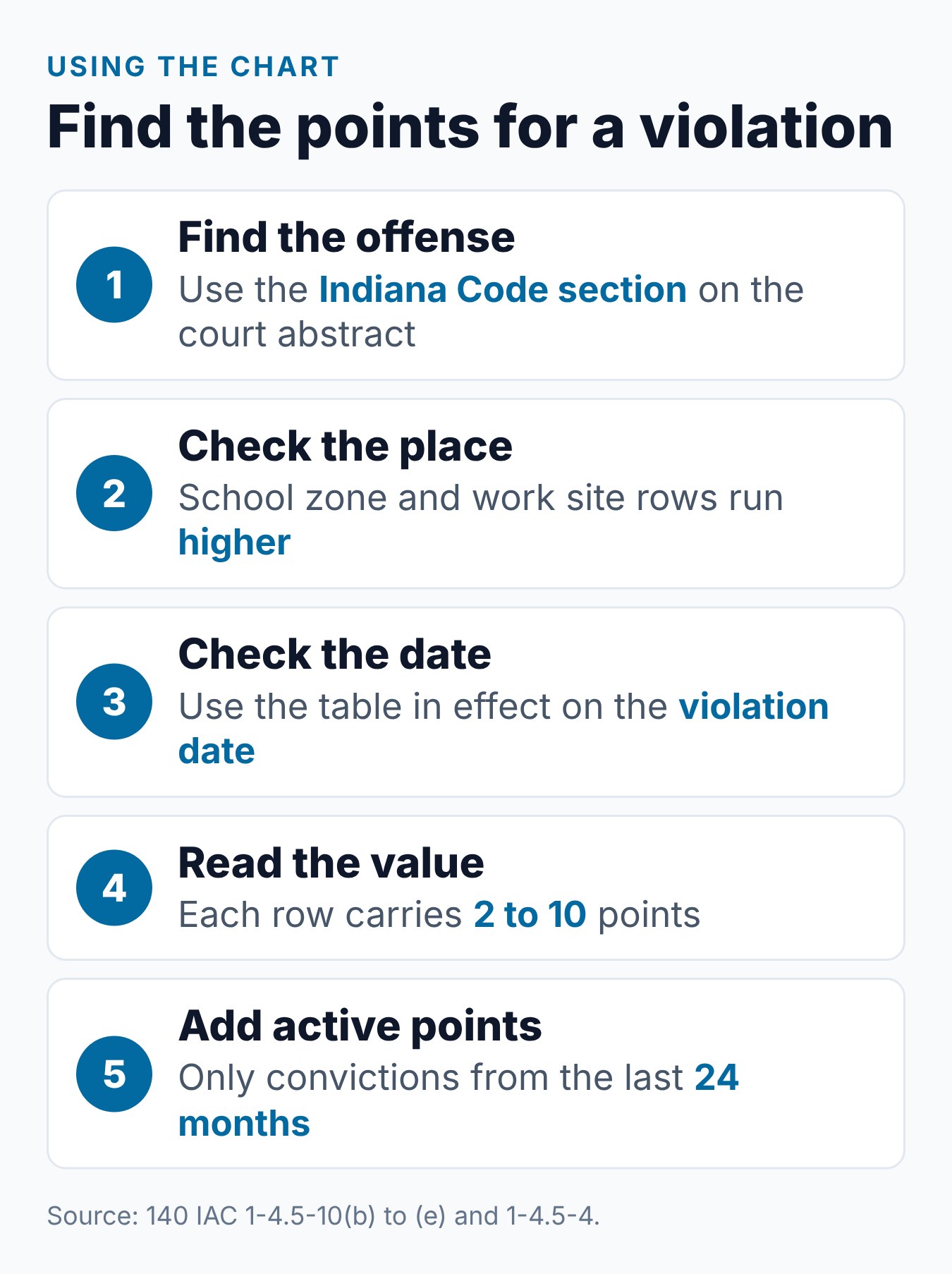
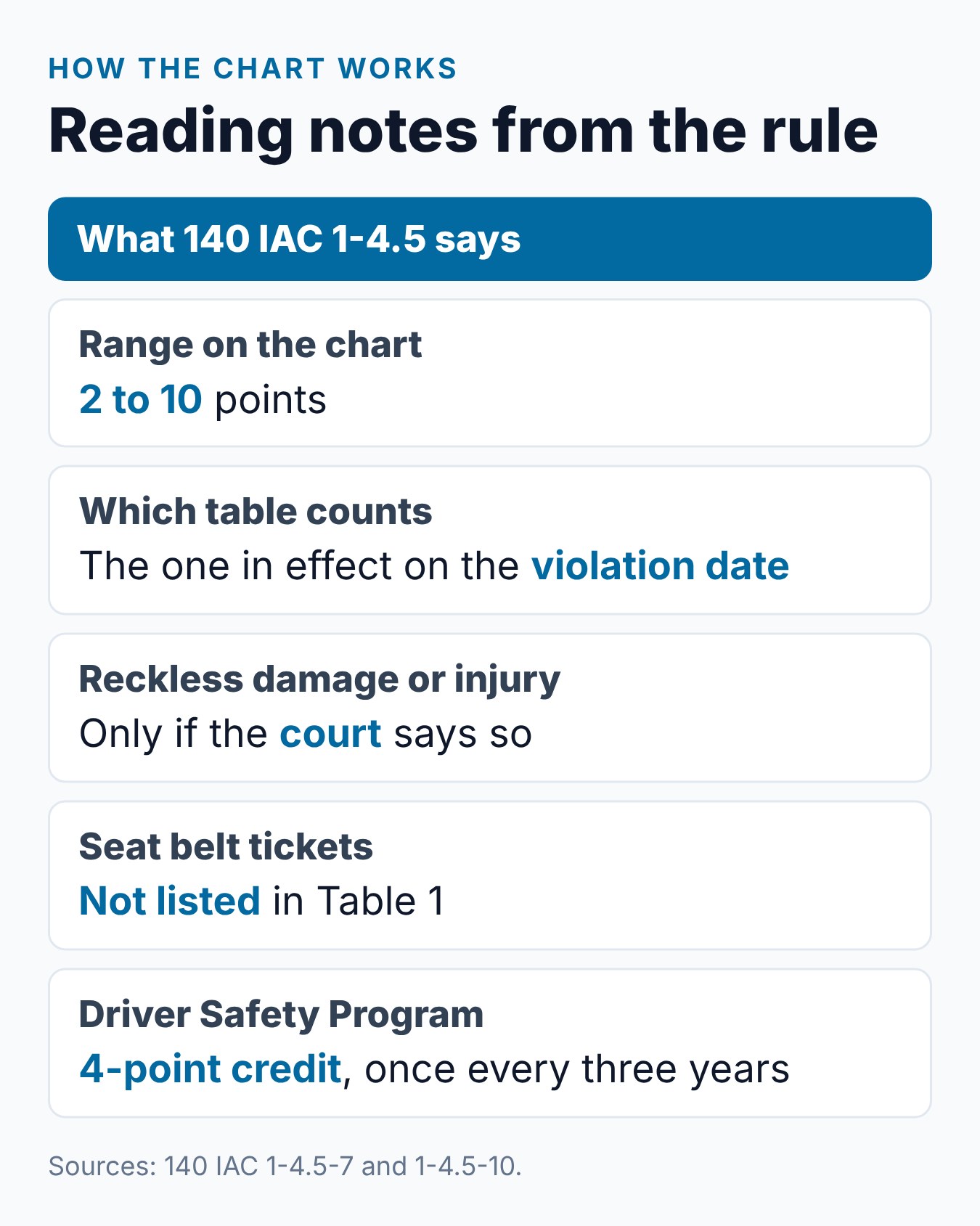
- Date of the violation. “The point value assigned to a violation shall be determined by the point value table in effect on the date the violation was committed.”
- How a court reports it. The BMV records the violation by its Indiana Code citation or BMV offense code from the court abstract. Out-of-state violations are recorded by a national code.
- Reckless driving extras. Property damage or injury “shall not be presumed” for reckless driving points unless the court says so.
- Leaving the scene. The rule treats it as a crash over $1,000 that requires a mandatory suspension, unless the court sets a lower amount.
Points are added after a conviction. The value then follows the violation code the court reported.
The Indiana BMV Points Chart by Violation Type
The tables below cover the main rows for everyday driving. They are not every row. For any violation not shown here, check Table 1 in the rule itself.
Speeding Rows
| Speed over the limit | Regular road (IC 9-21-5) | School zone | Work site |
|---|---|---|---|
| Amount not shown on the record | 2 | 4 | 4 |
| 1 to 15 mph | 2 | 4 | 4 |
| 16 to 25 mph | 4 | 6 | 6 |
| More than 25 mph | 6 | 8 | 8 |
Unsafe speed on a bridge or elevated structure (IC 9-21-5-10) is 4 points. School zone limits come from IC 9-21-5-6, and work site limits from IC 9-21-5-11. See speeding ticket points for worked examples.
Signal, Yield and Lane Rows
| Violation in Table 1 | Points |
|---|---|
| Disregarding a traffic control signal (IC 9-21-3) | 4 |
| Failure to yield, or to obey a stop or yield sign (IC 9-21-4) | 4 |
| Disregarding a stop sign at a railroad crossing | 6 |
| Improper U-turn (IC 9-21-8-19 and -22) | 4 |
| Improper driving on roads with traffic lanes (IC 9-21-8-11) | 4 |
| Following too closely (IC 9-21-8-14 to -16) | 6 |
| Failure to signal, or improper signal (IC 9-21-8-24 to -28) | 2 |
| Use of a telecommunications device while driving (IC 9-21-8-59) | 4 |
| Wrong way on a one-way road | 4 |
| Improper passing on the left of center | 6 |
| Disregarding the signal of an approaching train | 6 |
| Failure to exercise due care for a pedestrian | 6 |
| Failure to comply with an officer’s order | 6 |
Reckless and Aggressive Driving Rows
| Violation in Table 1 | Points |
|---|---|
| Reckless driving (IC 9-21-8-52) | 6 |
| Reckless driving with damage to property | 8 |
| Reckless driving with bodily injury | 10 |
| Reckless operation in a highway work zone (IC 9-21-8-56) | 8 |
| Reckless driving in a tractor-trailer | 8 |
| Aggressive driving (IC 9-21-8-55) | 8 |
| Drag racing | 8 |
| No-passing violation in a worksite | 8 |
Emergency Vehicle and School Bus Rows
| Violation in Table 1 | Points |
|---|---|
| Failure to yield to a moving emergency vehicle (IC 9-21-8-35(a)) | 6 |
| Failure to change lanes or slow down for a stopped emergency, recovery or maintenance vehicle (IC 9-21-8-35(b)) | 8 |
| Passing a school bus while it loads or unloads, or with its arm signal out (IC 9-21-12-1) | 8 |
Alcohol, License and Crash Rows
| Violation in Table 1 | Points |
|---|---|
| OWI or per se OWI (IC 9-30-5-1 and -2) | 8 |
| OWI causing serious bodily injury (IC 9-30-5-4) | 10 |
| OWI causing death (IC 9-30-5-5) | 10 |
| Driver under 21 with .02 to under .08 alcohol (IC 9-30-5-8.5) | 6 |
| Driving while license or privileges are suspended or revoked (IC 9-24-19) | 8 |
| Driving while suspended, with bodily injury or death | 10 |
| Driving while suspended as a habitual traffic violator | 8 |
| Leaving the scene of an accident (IC 9-26-1-1.1) | 8 |
| Leaving the scene, with injury or death | 10 |
| Operating without ever having a valid license | 6 |
| Consumption of alcohol while operating | 6 |
| Ignition interlock violation | 8 |
| Criminal recklessness with a vehicle | 8 |
| Obstruction of traffic causing serious bodily injury or death | 10 |
| Reckless homicide or manslaughter with a vehicle | 10 |
Equipment Rows
| Violation in Table 1 | Points |
|---|---|
| Brake equipment violation (IC 9-19-3-1) | 4 |
| Lights, reflectors, stop lights or warning signals (IC 9-19-6-1.5; IC 9-21-7-1) | 2 |
The Chart Sorted by Point Value
If you want to start from the number, here are the rows from the tables above sorted by value:
- 2 points: speeding 1 to 15 mph over; speeding with the amount not shown; failure to signal; lights and reflector equipment.
- 4 points: speeding 16 to 25 over; school zone or work site speeding up to 15 over; disregarding a signal; failure to yield; improper U-turn; improper lane driving; wrong way on a one-way road; phone use; brakes; unsafe speed on a bridge.
- 6 points: speeding over 25; school zone or work site 16 to 25 over; reckless driving; following too closely; failure to yield to a moving emergency vehicle; railroad crossing stop sign; train signal; passing left of center; pedestrian due care; an officer’s order; never licensed; alcohol while operating; under 21 with .02 to under .08.
- 8 points: school zone or work site over 25; reckless driving with property damage; reckless operation in a work zone; aggressive driving; the move-over rule; passing a stopped school bus; driving while suspended; OWI; leaving the scene; interlock violation; criminal recklessness with a vehicle.
- 10 points: reckless driving with bodily injury; driving while suspended with injury or death; OWI causing serious bodily injury or death; leaving the scene with injury or death; obstruction of traffic causing serious bodily injury or death; reckless homicide or manslaughter with a vehicle.
What Is Not on the Chart
Seat belt and child restraint violations do not appear in Table 1. So the chart assigns them no points.
The chart also does not list fines. Fines come from the court case, not from the BMV chart. Points are a separate BMV record.
How Chart Points Add Up
Points from each conviction add together while they are active. They stay active for 24 months after the conviction date.
Here is a simple example with three convictions:
- Following too closely: 6 points.
- Speeding 18 mph over: 4 points.
- Disregarding a signal: 4 points.
That is 14 active points. Under 140 IAC 1-4.5-4, 14 to 18 active points brings a warning notice.
At 20 or more within 24 months, a suspension starts. Our guides on what 8 points means and suspension levels go further.
Other Rules That Use Chart Points
Chart points feed into more than the warning and suspension levels. Three other rules matter:
- Renewal test. Under IC 9-24-12-5, a driver with 6 or more active points must pass a written test to renew. A driver under 21 with any active points must too.
- Out-of-state tickets. Under 140 IAC 1-4.5-5, a violation in another state gets the Indiana chart value when Indiana has a matching violation.
- No license. Under 140 IAC 1-4.5-8, a driver without a valid license gets the same points.
Two related rules do not use points at all. The BMV may call a hearing after three moving offenses in 12 months.
And a BMV-ordered Driver Safety Program comes from convictions or judgments, not a point total. See BMV-ordered DSP rules.
So a single 6-point conviction can matter at renewal, even though it is far from the warning range. Check your record before your renewal date.
The 4-Point Credit and the Chart
The chart sets what goes on. The Driver Safety Program (DSP) is the one BMV course that adds a credit against the total. Under 140 IAC 1-4.5-7, a BMV-approved DSP earns a 4-point credit, entered only once every three years.
In the example above, 14 points minus the credit leaves 10. That is below the warning range. The BMV’s Driver Safety Program page says completion “will not remove a citation from your driver history.” So the chart entry stays, even though the counted total drops.
Every approved course is at least 4 hours, and the BMV caps the price at $55. See how the 4-point credit works.
What We Found on the Official Pages
We compared the chart above with the 2026 edition of 140 IAC 1 on October 26, 2026. A readoption of the rule was filed on October 8, 2025. We found no change to the point values in the 2025 or 2026 updates.
The BMV’s Driver Record Points page matched the rule on timing. It says points stay active for two years from the conviction date.
Common Mistakes
These come straight from the rule text:
- Using the current chart for an old ticket. The table in effect on the violation date applies.
- Treating every OWI as 10 points. Plain OWI is 8; 10 is for serious bodily injury or death.
- Assuming reckless driving is 8 or 10. The higher values need the court to show damage or injury.
- Calling brake problems a 2-point item. Brake equipment is 4 points.
- Expecting seat belt points. Seat belt violations are not in Table 1.
- Thinking the credit deletes a row. The violation stays on the record.
How Requirements Can Vary
Indiana’s point rules, the 4-point credit and the BMV’s Driver Safety Program order come from state law and BMV rules, and they apply statewide. What you must do still depends on whether you take the course by choice, because of a BMV notice, or under a court order. A court order sets its own deadline and proof steps.
Laws, fees and court practice can change. Check your BMV notice, your court order and the Indiana BMV website for current rules before you enroll or file anything.
Frequently Asked Questions
What is the highest point value in Indiana?
Ten points. It applies to rows such as reckless driving with bodily injury, OWI causing serious bodily injury or death, and reckless homicide with a vehicle. Table 1 in the rule has the rest.
How many points is OWI in Indiana?
Plain OWI is 8 points. OWI causing serious bodily injury or death is 10 points.
How many points is texting while driving?
The table calls it use of a telecommunications device while operating a motor vehicle. It carries 4 points.
How many points is following too closely?
Six points under Table 1. It is one of the higher values for a non-speeding violation.
Are school zone and work site tickets worth more?
Yes. The same speed brings more points. For example, 16 to 25 mph over is 4 points on a regular road and 6 in a school zone or work site.
Which chart applies if the rules change?
The table in effect on the date you committed the violation. The date of your court case does not change the value.
Does the DSP change the chart?
No. The values stay the same. A BMV-approved course adds a 4-point credit against your total, once every three years.
Does a 6-point ticket affect renewal?
It can. Under IC 9-24-12-5, a driver with 6 or more active points must pass a written test at renewal. A driver under 21 needs the test with any active points.
Conclusion
The Indiana BMV points chart in 140 IAC 1-4.5-10 sets 2 to 10 points for each violation, based on the table in effect on the violation date. Use it to see how a conviction adds to your total.
You can earn the once-every-three-years 4-point credit with Driving Logic’s online Indiana Driver Safety Program. If a court ordered your course, check that the order allows an online course.
Related Articles
- Indiana Points on License: How the BMV System Works
- How Many Points Is a Speeding Ticket in Indiana?
- 8 Points on Your Indiana License: What It Means and What to Do
- Indiana License Suspension for Points: Thresholds, What Happens, and How to Reinstate
Sources
- 140 IAC 1-4.5 — BMV point system rules
- Indiana BMV — Driver Record Points
- Indiana BMV — Citation Points & Driver Safety Program
- Indiana Code § 9-21-5-2 — Maximum speed limits
- Indiana Code § 9-21-5-6 — Local and school zone speed limits
- Indiana Code § 9-21-5-11 — Worksite speed limits
- Indiana Code § 9-21-8-52 — Reckless driving
Billy Forte is the owner of Driving Logic, a state-approved driver improvement course provider serving Indiana and other U.S. states.
This article is general information, not legal advice. Indiana BMV rules, court orders, fines and penalties depend on your notice, citation, court and case facts, and they can change. Use official Indiana BMV and court sources, and consult a qualified Indiana attorney for advice about your own case.