
Updated October 2026 · Reviewed by Billy Forte
Florida teen driver license points follow one extra rule: if a driver aged 15 to 17 gets 6 or more points in 12 months, the license is limited to “business purposes only.” Teens also face the same point suspension levels as adults, plus driving curfews and a strict alcohol limit for drivers under 21. The Basic Driver Improvement (BDI) election works the same way for teens as for adults.
Key Facts
- The 6-point rule: 6 or more points in 12 months brings a “business purposes only” limit for ages 15 to 17. See the 6-point rule.
- How long it lasts: at least 1 year under the statute, plus 90 days for each new point during the restriction, ending at 18. See how long the limit lasts.
- Same suspension levels: 12, 18 and 24 points apply to teens too. See suspension levels for teens.
- Curfews: under 17, no driving 11 p.m. to 6 a.m.; at 17, no driving 1 a.m. to 5 a.m., with two exceptions. See teen curfews.
- Alcohol: under 21 with .02% or above means a 6-month suspension. See the under-21 alcohol rule.
How Florida Teen Driver License Points Work
Teens earn points the same way adults do. Each moving violation conviction adds points under s. 322.27. There is no separate teen point chart.
What changes is what happens next. A teen license has one rule adults do not face: the 6-point limit in s. 322.161. Teens also have curfews under s. 322.16.
Point Values Teens Should Know
A few values from s. 322.27(3)(d) show how 6 points can add up:
- Speeding 15 mph or less over the limit is 3 points. More than 15 mph over is 4 points.
- Careless driving is 3 points, or 4 if it causes a crash.
- Running a red light, when an officer writes the ticket, is 4 points.
- Passing a stopped school bus is 4 points, or 6 with serious injury or death.
- Any moving violation causing a crash is 4 points, or 6 if it was speeding or phone use.
Camera tickets, for a red light or a school zone, add zero points. For every offense, see the Florida traffic violation points chart.
The 6-Point Rule
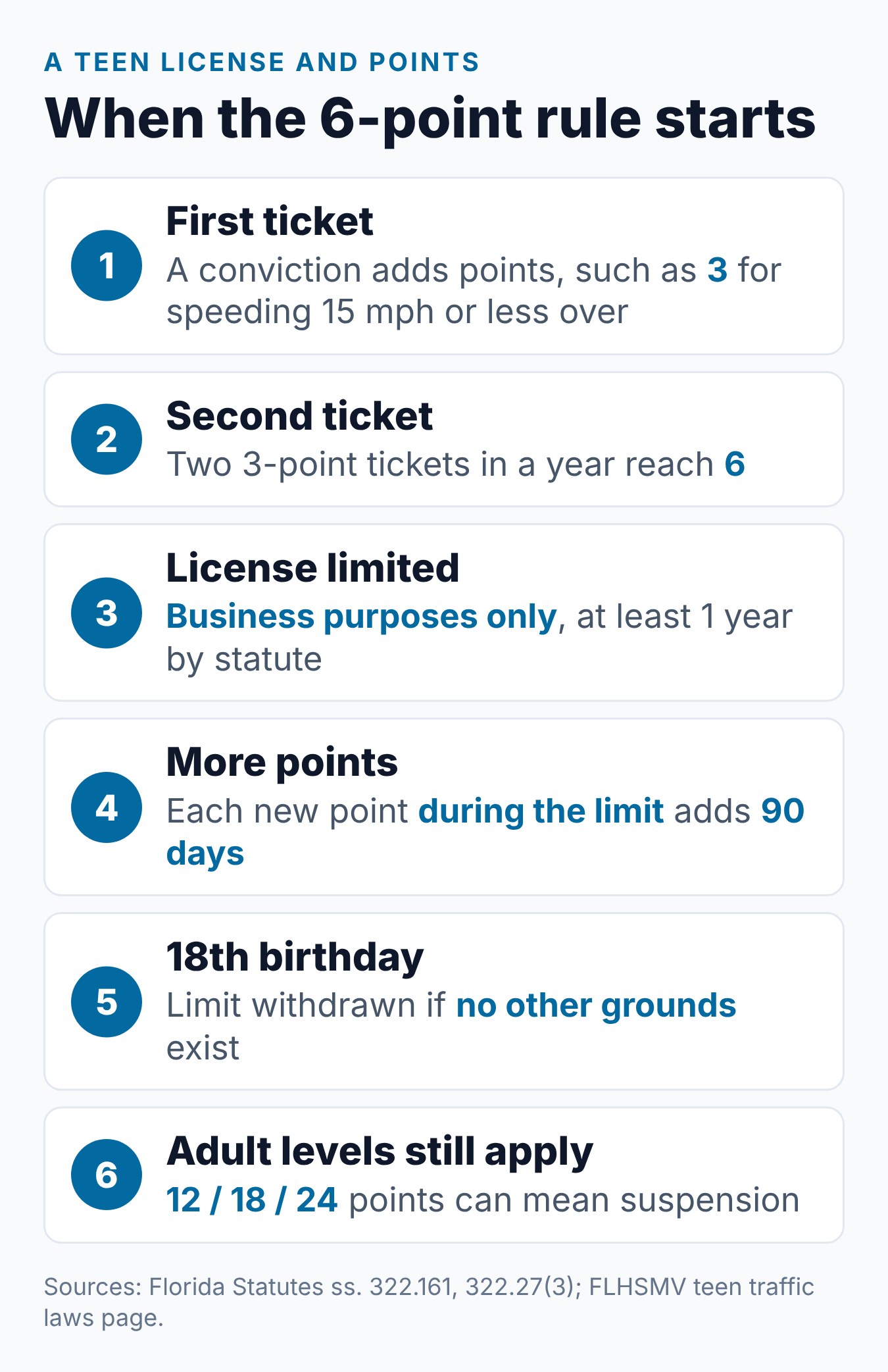
The rule applies to Class E licensees “who is age 15 through 17,” under s. 322.161. If such a driver gets 6 or more points within 12 months, the license becomes a “restricted license for business purposes only.”
The FLHSMV teen traffic laws page states the same trigger. It says the rule applies “If the minor receives six points on their driving record within a 12-month period.”
Here is the math. Two 3-point tickets within 12 months reach 6 points. One 4-point ticket plus one 3-point ticket makes 7, which is also past the limit.
Section 322.161 does not define business purposes. Ask FLHSMV what the limit allows in your case.
How Long the Limit Lasts
The statute and the FLHSMV page describe the length a little differently.
- The statute (s. 322.161): “The period of restriction shall be for a period of no less than 1 year.” It also says the limit is withdrawn “upon the licensee’s 18th birthday if no other grounds for restriction exist.”
- The FLHSMV page: the limit lasts “for 12 months or until they are 18, whichever happens first.”
Both sources add time for new points. If the teen gets more points, the statute says the period “shall be extended 90 days for each point.” FLHSMV says that if a teen gets more points during the restricted period, “the restriction is extended 90 days for each additional point.”
So if a teen gets 2 more points while restricted, the limit is extended 180 days. The 18th birthday can end the limit sooner if there are no other grounds.
Teen Rule Compared With Adult Rules
| Rule | Ages 15 to 17 | Adults |
|---|---|---|
| 6 or more points in 12 months | Business purposes only limit | No such limit |
| Point suspension levels | 12, 18 and 24 points | The same levels |
| Night driving | Curfew applies | No curfew |
| Under-21 alcohol rule | .02% or above: 6-month suspension | Ends at age 21 |
| BDI ticket election | Same rules | Same rules |
Suspension Levels for Teens
Teens are not on a separate suspension scale. The adult levels in s. 322.27(3) apply to every driver:
- 12 points in 12 months: up to 30 days.
- 18 points in 18 months: up to 3 months.
- 24 points in 36 months: up to 1 year.
These windows use offense dates, under s. 322.27(4). A teen who reaches 12 points in 12 months is past the 6-point limit and at the first suspension level, too.
After a points suspension, FLHSMV requires an Advanced Driver Improvement (ADI) course for a hardship license or reinstatement. Our license suspension guide explains those steps.
Teen Curfews
Section 322.16 sets driving hours for teen drivers:
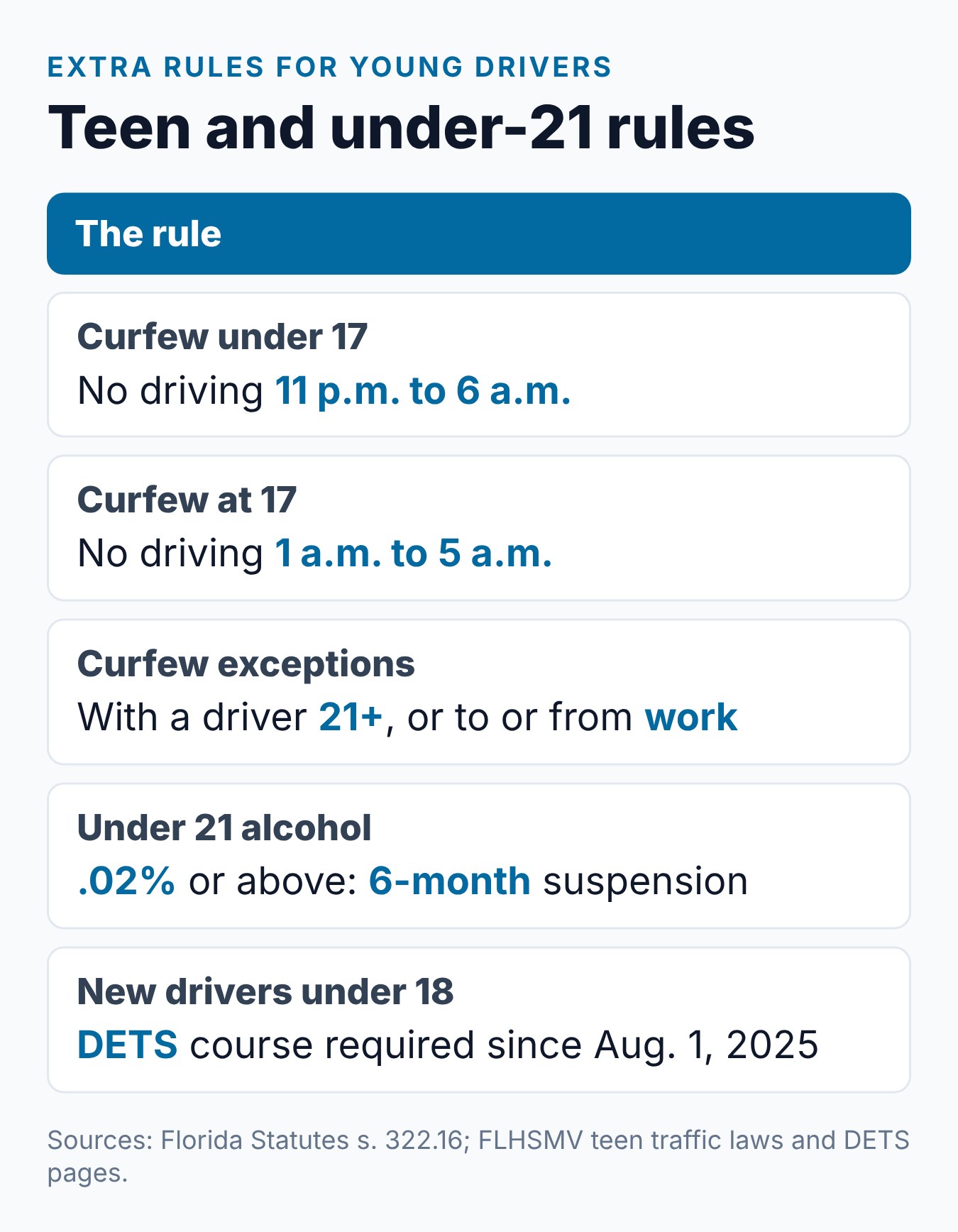
- Under 17: no driving between 11 p.m. and 6 a.m.
- Age 17: no driving between 1 a.m. and 5 a.m.
Two exceptions apply to both. A teen may drive in those hours with a licensed driver 21 or older, or when “driving directly to or from work.”
The Under-21 Alcohol Rule
Florida sets a low alcohol line for young drivers. The FLHSMV teen page says drivers under 21 with a blood alcohol level at or above .02% will “have their license immediately suspended for six months.”
This rule covers drivers up to age 21, not only teens. It is separate from the point system.
Can a Teen Elect BDI?
Yes, if the ticket and driver qualify. The BDI election in s. 318.14(9) has the same rules for teens as for adults. After an eligible election, adjudication is withheld, no points are added for that ticket, and the civil penalty is cut by 18 percent.
That matters more for a teen. A ticket with no points does not count toward the 6-point limit.
The FLHSMV BDI page sets the steps. You tell the Clerk of Court in the county on the ticket within 30 days, before taking the course, and pay the clerk’s election fee.
The usual limits apply:
- no election for speeding 30 mph or more over the limit;
- no election for tickets that need a court hearing under s. 318.19;
- no election if one was made in the preceding 12 months; and
- no more than eight elections in a lifetime.
The clerk or court sets the finish date. If a teen elects and pays but does not finish in time, s. 318.15(1)(b) says the teen is adjudicated guilty and points are assessed.
The 18 percent cut must be repaid, plus a processing fee of up to $18. Separately, s. 318.15(1)(a) lists failing to attend driver improvement school among the failures the clerk reports to FLHSMV, which then suspends the license.
BDI Is Not the Teen Licensing Course
BDI is a different course from the one new teen drivers take to get a license. The FLHSMV DETS page covers the Driver Education Traffic Safety (DETS) course. It has been required for new drivers under 18 since August 1, 2025.
DETS does not replace a BDI election, and BDI does not replace DETS. Each course has its own purpose and rules.
How Long Teen Points Stay
Points do not leave the record at 18. The FLHSMV points page sets a floor: points stay at least five years from the date of disposition.
So points from a ticket decided at age 16 can still be on the record at age 21. Our guide on how to check points shows how to see them.
Tickets From Other States
A ticket from another state can count, too. Section 322.27(3)(e) lets FLHSMV give an out-of-state conviction the same points it would carry here. Ask FLHSMV how they apply to the 6-point rule.
Teen Tickets and Insurance
Florida law limits how insurers use some tickets, and those limits apply at any age. Under s. 626.9541(1)(o)12, an elected ticket with adjudication withheld and no points cannot be the reason an insurer adds a premium, cancels or refuses to renew. An at-fault crash where the insurer had a loss is the exception.
A second rule, s. 626.9541(1)(o)4, covers a single noncriminal ticket. An insurer may not add a premium for that one ticket alone, unless it is a second within 18 months, a third within 36 months, or speeding over 15 mph above the limit. Camera tickets also cannot be used to set rates.
What We Found on the Official Pages
When we compared s. 322.161 with the FLHSMV teen page on October 27, 2026, the 6-point trigger matched. The length did not read the same way. Section 322.161 said “no less than 1 year,” while the FLHSMV teen page said “12 months or until they are 18, whichever happens first.”
The statute controls: at least 1 year, withdrawn at 18 if no other grounds exist. Ask FLHSMV how it applies in your own case.
Common Mistakes
These mistakes are checked against Florida statutes and FLHSMV pages:
- Thinking teens have lower suspension levels. They face the same 12, 18 and 24-point levels.
- Missing the 6-point limit. Two 3-point tickets in 12 months can trigger it.
- Thinking points clear at 18. Points stay at least 5 years from disposition.
- Forgetting the extra 90 days. Each new point during the restriction adds 90 days.
- Ignoring the work exception. Driving directly to or from work is allowed during curfew hours.
- Mixing up DETS and BDI. They are different courses.
How Requirements Can Vary
Florida’s election rules, point values and suspension levels come from Florida Statutes and FLHSMV, and they apply statewide. The election fee, the date to finish the course and how proof is filed are set by the Clerk of Court in the county on your ticket, or by the court. A court order sets its own deadline and proof steps.
Laws, fees and clerk practice can change. Check your citation, your clerk’s instructions, any court order and the FLHSMV website before you enroll or file anything.
Frequently Asked Questions
How many points does it take to restrict a teen license in Florida?
Six or more points within 12 months, for a Class E licensee aged 15 to 17. The license is then limited to business purposes only.
How long does the business purposes only limit last?
The statute says at least 1 year, plus 90 days for each new point during the restriction, withdrawn at 18 if no other grounds exist. FLHSMV says 12 months or until 18, whichever happens first.
Do teens have different suspension levels?
No. The levels of 12 points in 12 months, 18 in 18 months and 24 in 36 months apply to every driver.
Can a teen take BDI for a ticket?
Yes, if the ticket and driver qualify. The election rules are the same as for adults, and an elected ticket adds no points.
What are the teen driving curfews in Florida?
Under 17, no driving from 11 p.m. to 6 a.m. At 17, no driving from 1 a.m. to 5 a.m. Both allow driving with a licensed driver 21 or older or directly to or from work.
Do teen points go away at 18?
No. The business purposes only limit can end at 18, but the points stay. FLHSMV says points remain on the record at least 5 years from the date of disposition.
Do camera tickets count toward the 6 points?
No. Camera tickets for a red light or a school zone carry zero points, so they add nothing toward the 6-point limit.
What happens if a driver under 21 has .02% blood alcohol?
FLHSMV says a driver under 21 with a blood alcohol level of .02% or above has the license suspended for six months.
Conclusion
Florida teens earn points like adults, but 6 or more points in 12 months limits a license to business purposes only. The same suspension levels, teen curfews and the under-21 alcohol rule also apply.
An eligible BDI election within 30 days keeps points off a new ticket. When you have elected, you can take the Florida BDI course online.
Related Articles
- Florida Driver License Points System: Suspensions, Point Values, and BDI Options
- Florida License Suspension for Points: What Happens and Reinstatement Options
- Florida Traffic Violation Points Chart: How Many Points for Each Offense
- How to Check Points on License Florida: Your FLHSMV Record
Sources
- Florida Statutes s. 626.9541 — Unfair insurance trade practices
- FLHSMV — Traffic Laws for Florida Teens
- Florida Statutes s. 322.161 — High-risk drivers; restricted licenses
- Florida Statutes s. 322.16 — License restrictions
- Florida Statutes s. 322.27 — Authority to suspend or revoke a license (point system)
- FLHSMV — Points and Point Suspensions
- Florida Statutes s. 318.14 — Noncriminal traffic infractions; procedures
- FLHSMV — Basic Driver Improvement (BDI) Approved Course Providers
- FLHSMV — Driver Education Traffic Safety (DETS) Course
- Florida Statutes s. 318.15 — Failure to comply with civil penalty or to appear
Billy Forte is the owner of Driving Logic, a driver improvement course provider serving Florida and other U.S. states.
This article is general information, not legal advice. Election rules, deadlines, fines and penalties depend on your citation, county, court and case facts, and they can change. Use official FLHSMV, Florida Statutes and Clerk of Court sources, and consult a qualified Florida attorney for advice about your own case.