
Updated October 2026 · Reviewed by Billy Forte
If you searched how much is a red light ticket in florida, the penalty is $158, and a ticket from a red light camera adds no points to your license. A red light ticket written by a police officer is also $158, but it adds 4 points. Florida law also says a camera violation may not be used to set your car insurance rates.
Key Facts
- Penalty: $158, whether a camera or an officer catches it. See the penalty.
- Camera points: none, and the violation may not be used to set insurance rates. See why no points.
- Officer points: 4 points for running a red light. See officer tickets.
- Timeline: a notice goes out within 30 days, and you have 60 days to pay or ask for a hearing. See the timeline.
- Owner rules: the registered owner is liable unless an affidavit applies. See if you were not driving.
Camera Ticket or Officer Ticket
A red light violation can reach you in two ways. A camera can record it, or a police officer can stop you and write a ticket. The amount is the same, but the points are not.
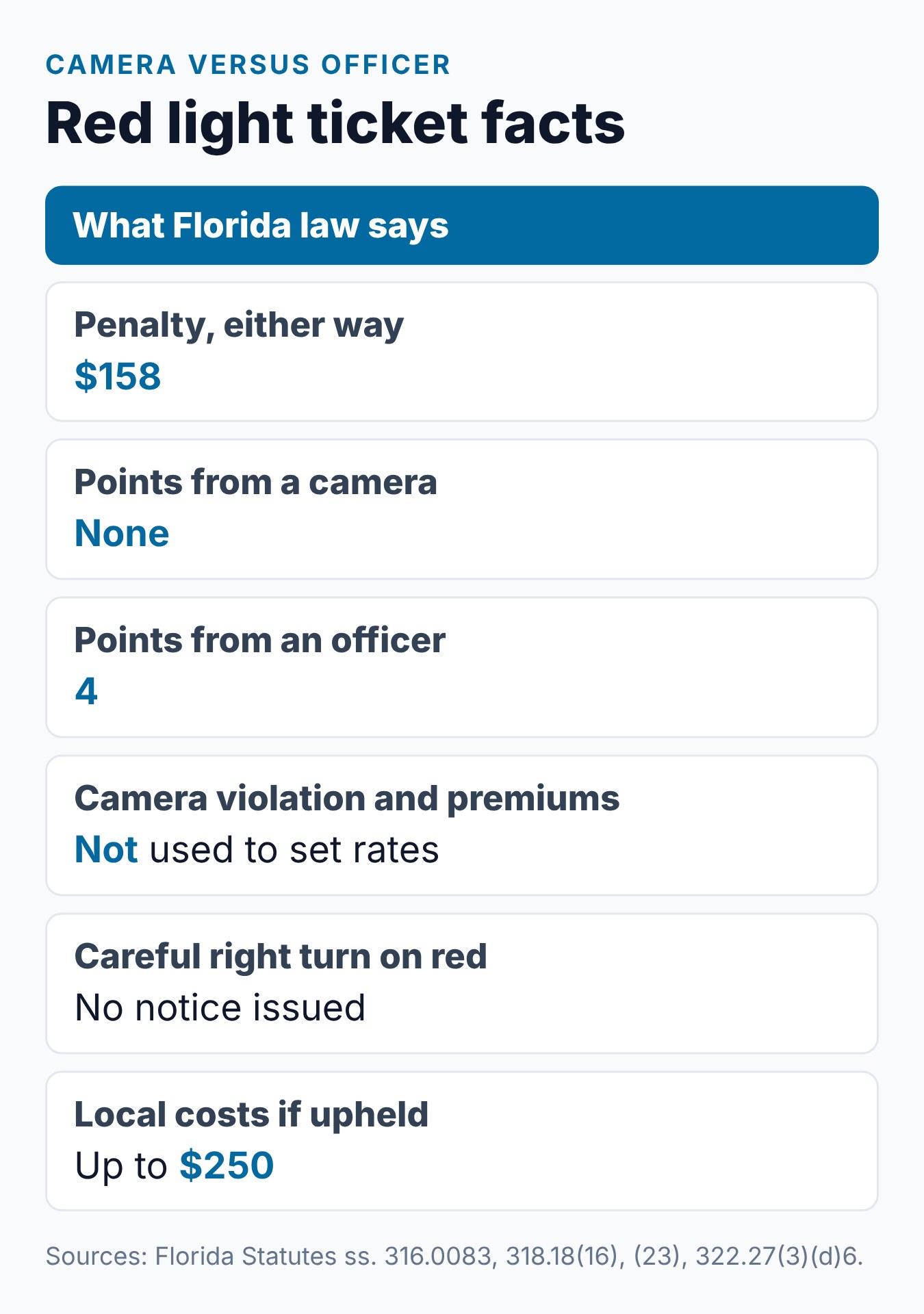
| Who caught it | Penalty | Points | Insurance rate rule |
|---|---|---|---|
| Red light camera | $158 | 0 | May not be used to set rates |
| Police officer at the scene | $158 | 4 | Regular rules in s. 626.9541 |
Camera violations are enforced by a traffic infraction enforcement officer. That is the term the law uses. These officers can work for the state, a county or a city.
How Much Is a Red Light Ticket in Florida
The amount comes from s. 318.18(16)(a). It sets “One hundred and fifty-eight dollars” for failing to stop at a traffic signal. The same $158 applies when a police officer enforces it and when a state, county or city traffic infraction enforcement officer does.
The camera law repeats the amount. Under s. 316.0083, the notice must say “that the violator must pay the penalty of $158.”
One added cost can follow a hearing. If the hearing officer upholds the violation, s. 318.18(23) allows county or city costs “not to exceed $250.” Your notice or citation shows the amount you owe.
Why a Camera Ticket Adds No Points
The no-points rule is in the points law, s. 322.27(3)(d)6. It says, “points may not be imposed” for a red light violation “when enforced by a traffic infraction enforcement officer.”
The same part of the law covers insurance. It says the violation “may not be used for purposes of setting motor vehicle insurance rates.”
So a camera ticket has two limits built into the law:
- No points go on your license for it.
- No insurance rate may be set because of it.
A camera ticket still has to be handled. Ignoring the notice leads to a traffic citation, as the next section shows.
The Camera Notice Timeline
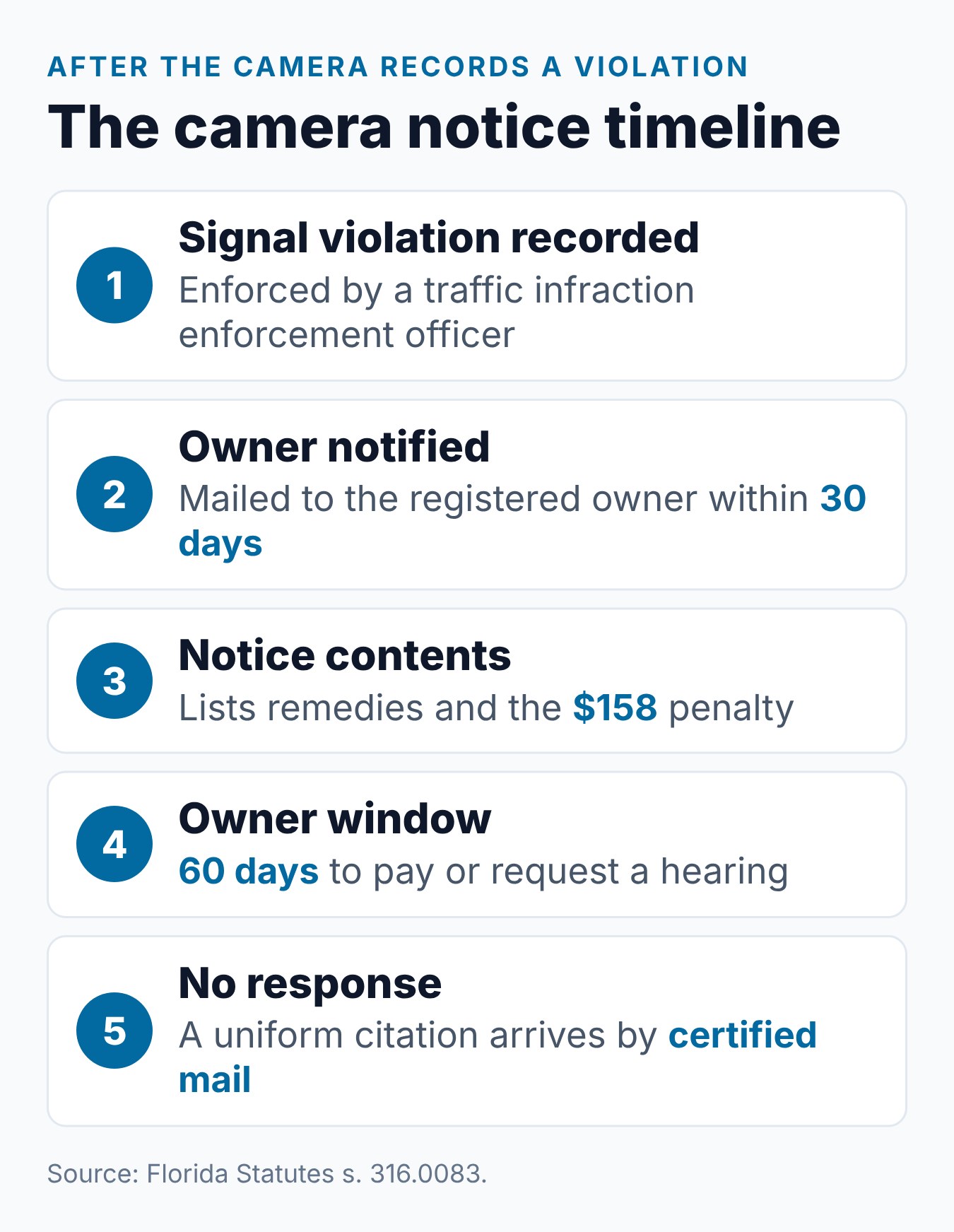
The camera law sets a clear order of events. Each step has its own deadline.
- The notice. “Within 30 days after a violation,” a notice goes to the registered owner of the vehicle.
- What it says. The notice names “the remedies available under s. 318.14” and the $158 penalty.
- Your window. You have 60 days from the notice date to pay or “request a hearing.”
- The citation. If you do neither, a traffic citation is mailed “by certified mail.”
The 60 days are counted “following the date of the notification.” Paying or asking for a hearing in that time keeps the citation from being issued. Read your notice for the exact dates and the agency to contact.
Asking for a Hearing on a Camera Notice
A hearing is the other choice on a camera notice. You must request it within the same 60 days. The request also keeps a traffic citation from being mailed in that time.
At the hearing, a hearing officer decides whether the violation stands. If it is upheld, you owe the $158. Section 318.18(23) also lets a county or city add costs “not to exceed $250.”
The notice names the agency that runs the hearing. Use the contact details on it, since this guide cannot list local offices.
If You Were Not Driving
A camera ticket goes to the vehicle’s owner, not the driver. Section 316.0083 says, “The owner of the motor vehicle involved in the violation is responsible and liable for paying” it.
The law gives owners a way out in some cases. Under s. 316.0083(1)(d), an owner who was not driving can file an affidavit. That subsection sets out the affidavit options.
If you own the car but someone else drove it, read the affidavit rules in that subsection closely. They are the path the law gives an owner in that case.
Right Turns on Red
Florida law protects careful right turns. Section 316.0083 says a notice “may not be issued for failure to stop at a red light if the driver is making a right-hand turn in a careful and prudent manner.”
The key words are “careful and prudent.” The law does not exempt every right turn on red.
Red Light Tickets From an Officer
A ticket from a police officer is different. Under s. 322.27(3)(d)6, failing to stop at a traffic signal carries 4 points when an officer enforces it.
Those points count toward FLHSMV’s suspension levels. A total of 12 within 12 months allows a suspension of up to 30 days. Higher totals over longer windows allow up to 3 months or up to 1 year.
For example, three officer-issued red light tickets in 12 months reach 12 points. Per the FLHSMV points page, they remain on the record a minimum of 5 years after disposition.
An officer’s ticket follows the usual 30-day choices. Within that time you may pay it, request a hearing, or elect a Basic Driver Improvement (BDI) course when eligible. The election rules in s. 318.14(9) apply, including the CDL bar and the 12-month limit.
A valid election means no points for that ticket and an 18 percent cut to the civil penalty. Our guide to Florida ticket options compares the three choices.
Electing BDI for an Officer’s Ticket
The election has steps and limits of its own. Within 30 days of the ticket date, you tell the Clerk of Court in the county on the ticket. You do this before you take the course, and you pay the clerk’s election fee.
The court or clerk then sets the date to finish. There is no statewide window. If you do not finish in time, you are found guilty, the 4 points are added, and you repay the 18 percent cut plus a processing fee of up to $18.
You also cannot elect if you made an election in the preceding 12 months. Florida caps elections at eight in a lifetime.
If an Officer’s Ticket Is Ignored
An officer’s ticket needs an answer within 30 days, under s. 318.14(4). If you do not pay, appear at a hearing or attend driver improvement school, the clerk notifies FLHSMV. FLHSMV then suspends your license under s. 318.15.
School Zone Speed Cameras Follow a Similar Rule
Red light cameras are not the only cameras in Florida law. School zones can have speed cameras, too. Under s. 322.27(3)(d)5.c, no points are imposed for those camera tickets either.
The school zone camera fine is $100, for going more than 10 mph over the school zone limit. Like a red light camera ticket, it may not be used to set insurance rates. Our school zone and work zone guide explains when those limits apply.
Insurance and Your Record
The two kinds of tickets are treated differently for insurance, too.
- Camera ticket: s. 322.27(3)(d)6 says it may not be used to set insurance rates.
- Officer ticket, paid: s. 626.9541(1)(o)4 bars a surcharge for one noncriminal ticket alone. A second ticket in 18 months or a third in 36 months is an exception.
- Officer ticket, elected: with adjudication withheld and no points, s. 626.9541(1)(o)12 stops an insurer from adding premium, canceling or refusing renewal over it. The exception is an at-fault crash that caused the insurer a loss.
Our car insurance guide covers these rules in depth.
What We Found on the Official Pages
When we reviewed these laws and the FLHSMV site on October 27, 2026, two details stood out.
First, the camera law, s. 316.0083, never uses the word “points.” The no-points rule lives in s. 322.27 instead.
Second, the FLHSMV points page lists “Fail to obey traffic control signal (Failed to stop at traffic signal/red light)” at 4 points. It also shows a separate “Fail to stop at STEADY RED signal” row at 3 points.
The statute, s. 322.27(3)(d)6, gives 4 points for failing to stop at a red light, and the statute controls. If your record shows a different number, ask FLHSMV.
Common Mistakes
Each item below comes from Florida Statutes:
- Ignoring the camera notice. After 60 days without payment or a hearing request, a citation is mailed.
- Expecting points from a camera. The law says points may not be imposed.
- Expecting no points from an officer. An officer’s red light ticket carries 4 points.
- Treating every right turn as safe. Only a turn “in a careful and prudent manner” is protected.
- Assuming the driver gets the notice. It goes to the registered owner.
- Missing the 30 days on an officer’s ticket. The clerk then notifies FLHSMV, which suspends your license.
- Expecting an insurer to use a camera ticket. The law bars its use for setting rates.
How Requirements Can Vary
Florida’s election rules, point values and suspension levels come from Florida Statutes and FLHSMV, and they apply statewide. The election fee, the date to finish the course and how proof is filed are set by the Clerk of Court in the county on your ticket, or by the court. A court order sets its own deadline and proof steps.
Laws, fees and clerk practice can change. Check your citation, your clerk’s instructions, any court order and the FLHSMV website before you enroll or file anything.
Frequently Asked Questions
Does a red light camera ticket add points in Florida?
No. Section 322.27(3)(d)6 says points may not be imposed when a traffic infraction enforcement officer enforces the violation. That is how camera tickets are handled.
Does a camera ticket cost the same as an officer ticket?
Yes. Both are $158 under s. 318.18(16)(a). The points and the insurance rule differ: a camera ticket adds 0 points and may not be used to set insurance rates, while an officer’s ticket adds 4 points.
Who has to pay if someone else was driving?
The registered owner is liable under s. 316.0083. An owner who was not driving can file an affidavit under s. 316.0083(1)(d).
How long do I have to respond to a camera notice?
You have 60 days from the notice date to pay or ask for a hearing. If you do neither, a traffic citation is mailed by certified mail.
Can I elect traffic school for a camera ticket?
The camera law says the notice lists “the remedies available under s. 318.14.” The pages we checked do not say more than that. Ask the agency or clerk named on your notice.
Can I get a camera ticket for turning right on red?
Not for a careful one. Section 316.0083 says a notice may not be issued when the driver makes a right-hand turn “in a careful and prudent manner.” A turn that does not meet that test is not protected.
Will a camera ticket raise my insurance?
Florida law says a camera red light violation “may not be used for purposes of setting motor vehicle insurance rates.” An officer’s ticket follows the regular insurance rules instead.
Conclusion
A Florida red light ticket costs $158, but only an officer’s ticket adds 4 points. A camera ticket adds none and may not be used to set insurance rates, though its 60-day deadline still matters.
If you qualify to elect on your ticket, you can take the Florida BDI course online. Anyone with a court-ordered course should follow that order and check with the court or clerk when unsure.
Related Articles
- Florida Traffic Ticket: Costs, Points, and Traffic School Options
- Florida Traffic Ticket Options: Pay, Elect Traffic School, or Contest
- Florida Traffic Ticket Insurance: What the Law Says
- Florida School Zone and Work Zone Speeding Tickets: Higher Fines and BDI Options
Sources
- Florida Statutes s. 316.0083 — Mark Wandall Traffic Safety Program (red light cameras)
- Florida Statutes s. 318.18 — Amount of penalties
- Florida Statutes s. 322.27 — Authority to suspend or revoke a license (point system)
- Florida Statutes s. 318.14 — Noncriminal traffic infractions; procedures
- Florida Statutes s. 318.15 — Failure to comply with civil penalty or to appear
- Florida Statutes s. 626.9541 — Unfair insurance trade practices
- FLHSMV — Points and Point Suspensions
Billy Forte is the owner of Driving Logic, a driver improvement course provider serving Florida and other U.S. states.
This article is general information, not legal advice. Election rules, deadlines, fines and penalties depend on your citation, county, court and case facts, and they can change. Use official FLHSMV, Florida Statutes and Clerk of Court sources, and consult a qualified Florida attorney for advice about your own case.